
In this blogpost we dive deeper into the soil characteristics of one of the most common construction materials – Sand. Throughout this blogpost we will try and characterize sand as a building and natural material.
- Why is sand called sand
- What characterizes sand grains
- What color is sand?
- Why is sand attracted to water?
- How many types of sand exist?
- What is the importance of sand
- Can we run out of sand?
- Conclusion
- References
Why is sand called sand
Lets start of with a small history lesson of why sand is called sand in the first place. The word “Sand” comes from the old English word of “sund” which referred to the ground, soil or earth.
With the advent of time the meaning of sand have changed from loosely describing earth and ground, to the present day version describing a granular, particulate in-cohesive substance most commonly associated with the beach sands and backyard playing ground equivalents.
Common and professional usage of the word sand
Comparatively sand refers in professional terms to building material used in concrete mixing, as a pore-breaking material underneath foundations and walkway substrate in parks and forests. In contrary the layman term of sand refers more to the old English “sund” version.
What characterizes sand grains
One of the defining characteristics of sand is the granular size. The granular size of particles is important when trying to characterize sand properly. In geotechnical terms the governing common definition of sand is a substrate whose particle grain sizes varies between 0.063 and 2 millimeters.
Geotechnical definition of sand
The importance of this distinction lies in the physical properties of particles within this size range whose characteristics are particularly useful for construction, filtering, crafting and mixture purposes but more on that later.
Sand grain characteristics through a lens
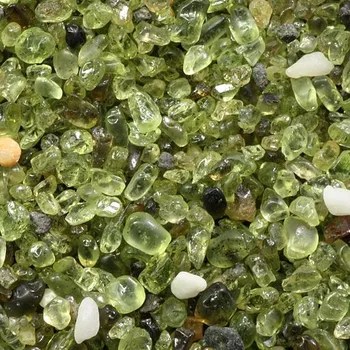
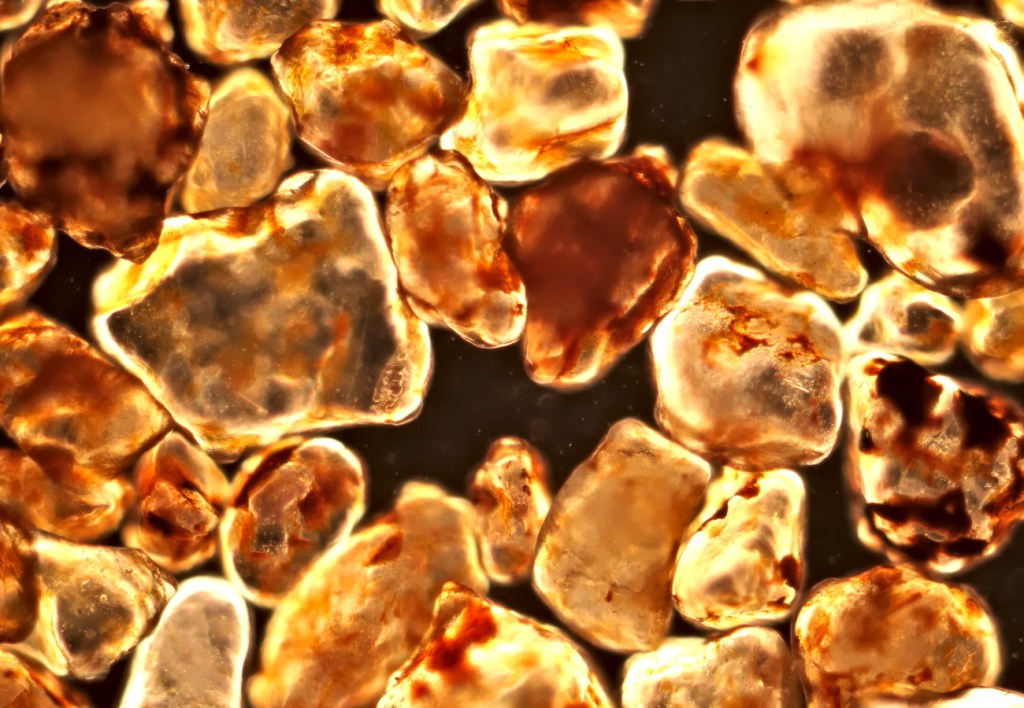
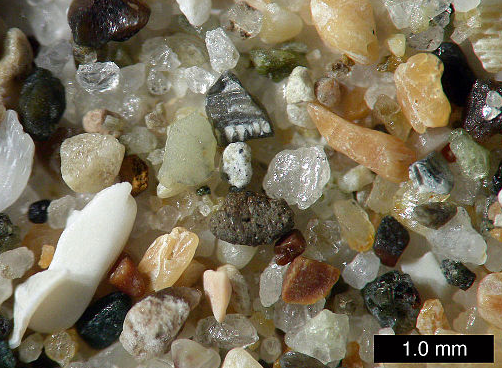
Although the size range of sand particles is strictly defined by radius, their actual shapes, sizes, and forms can vary in three dimensions. Microscopes enable researchers and engineers to characterize differences in individual particles’ sharpness and skewness factors. The variations among individual sand particles are easily observed through a microscope. Refer to Gallery 1 for examples of sand grains from around the world.

What color is sand?
The color of sand varies greatly with the mineral content as the mineral composition determines the light refraction indices that make up color of solid particles. Typically the mineral composition of sand consists of quartz. Quartz is a hard, crystalline material composed of silica.
Minerals found in sand
However the mineral composition of sand is far from regular as often times the deposition consists of a mixture of some of the following minerals:
- Quartz: A hard, crystalline mineral often appearing clear or white, though it can also be found in shades of pink, yellow, and gray.
- Feldspar: A group of minerals including orthoclase, plagioclase, and microcline. Feldspar is often white, pink, or gray in color.
- Mica: Known for its shiny, reflective surface, mica can be found in a variety of colors, including white, brown, and black.
- Olivine: A green, iron-rich mineral commonly found on beaches and in volcanic areas.
- Calcite: Often found in sandstone and limestone, calcite is typically white or colorless but can also be found in shades of yellow, green, and blue.
- Magnetite: A black, iron-rich mineral.
- Garnet: A red or brown mineral found on beaches and in riverbeds.
- Rutile: A titanium mineral often found in coastal areas. Rutile is typically reddish-brown or black and has a distinctive metallic luster.
- Zircon: Commonly found in beach and river environments, zircon is usually brown or reddish-brown and has a high refractive index, giving it a brilliant luster.
- Tourmaline: A mineral frequently found in beach environments and is found in a range of colors, including black, green, pink, and blue.
- Gypsum: Often found in sand dunes and other desert environments, gypsum is typically colorless or white and has a soft, powdery texture.
- Pyrite: A sulfide mineral with a metallic luster, pyrite is typically a brassy yellow color.
- Halite: Commonly found in desert regions, halite is also known as rock salt and is typically colorless or white.
This is not an exhaustive list of all the minerals found in sand, but it includes some of the most common minerals found on beaches, in rivers, and in deserts.
As the composition of sand can vary greatly depending of the type of sand, location and weathering effects, the actual color of sand can vary greatly even within the same sample of grains! see Gallery 1 for examples. Although the composition of minerals differs within each of the sand grains one characteristic which is continuous is the adherence to water.
Why is sand attracted to water?
Sand does not attract water. Instead, water easily passes through sand. People often mistakenly believe that sand is almost magnetic and attracts water. However, this is far from the truth.
The composition and compactness of sand allow individual water molecules to fit easily between sand grains. This characteristic enables sand to function as a porous substrate, allowing water to flow through the compacted medium at a reasonable rate.
The flow of water through a medium
Darcy’s law, shown below, governs the flow of water through a medium, particularly a substrate.
This law in three-dimensions govern the flow of water through the underground for fully saturated soils assuming laminar flow. For sand in particular, the values for the hydraulic conductivity K, are high resulting in a relatively speaking geotechnical context fast paced flow patter through water.
Darcy flow experiment
In order to correctly estimate such flow rates through saturated soils, Darcy produced an experiment determining the pressure loss between points of interest based on flowrates of water.
To investigate his hypothesis concerning the governing parameters of soil flow rates, he devised an apparatus designed specifically to measure flow rates through solid medium, see Figure 2.
The results of typical Darcy flow experiments in modern time results in parameter estimates which coarsely have characteristic hydraulic conductivity values in the ranges presented in table 1, here considering sand substrates only.
| Type of sand | Hydraulic conductivity [m/s] |
| Corse sand | 9 * 10-7 to 6 * 10-3 |
| Medium sand | 9 * 10-7 to 5 * 10-4 |
| Fine sand | 2 * 10-7 to 2 * 10-4 |

Darcy’s apparatus enables him to study the relationship between pressure and flowrate in saturated soils. This device forms the foundation for most groundwater flow models, which can incorporate advanced features such as non-stationary gradients, rocks, unsaturated flow, and varying water tables through aquifers, along with other parameters.
How many types of sand exist?
There exist a plethora of sand types throughout the globe. The individual characterization of different sand compositions in minerals, weathering effects and similar arises from the differences in earths soil, climate and type of origination. A specific number of sand types is thus impossible to give a precise picture of. However if pressed one possible way of characterizing soils in general is through their grain size distributions.
Grain size distributions
The grain size distribution allow a characterization of soils and in particular sand through the use sieves throughout the soil sample. The grain size distribution is important to understand as the defining mechanical and physical behavior of the soil sample depend heavily on the grain size distribution, shape and sharpness of the individual grains.
Laboratory equipment
In order to characterize and calculate a grain size distribution, one should utilize sieves with different mesh sizes. The sieving systems regularly used for commercial grain size characterizations varies widely based on their intended purposes from small microscale sieves to cm wide appliances. An overview of some of the sieve sizes are outlined in the excellent resource in the references.
Additionally, as any laboratorian knows, before conducting a grain size distribution analysis, you’ll need laboratory-grade scales capable of measuring weights from 0.01 grams to 5000 grams. This scale range allows you to weigh both sieves with and without soil, as well as calculate the percent finer settlement.
Finally, the sieve stack shaker is an essential piece of test equipment for performing a sieve analysis with resulting grain size distribution.
By utilizing this equipment and measuring the weight before and after, it is possible to perform a grain size distribution characterization of a given soil sample.
Procedure for production of a grain size distribution
The procedure for performing the a grain size distribution analysis has the following steps:
- Weigh sample before sieving.
- Weigh each individual sieves when they are empty
- Note down individual mesh sizes
- Stack sieves from coarsest to finest meshes in the shaker stack.
- Pour soil sample from the top of the sieve stack
- Start the stack soil shaking apparatus
- Shake samples for approximately 24 hours
- Split up shaker stack and weigh residual soil in each individual sieves
- Subtract original sieve masses to obtain residual mass of soil
- Calculate the percent finer from the original soil weight.
- Plot mesh particle size versus the percent finer % from the soil sample
- Perform the grain size distribution plot
By following the above steps you will be able to perform an analysis of the grain size distribution whose result will be in a similar form.
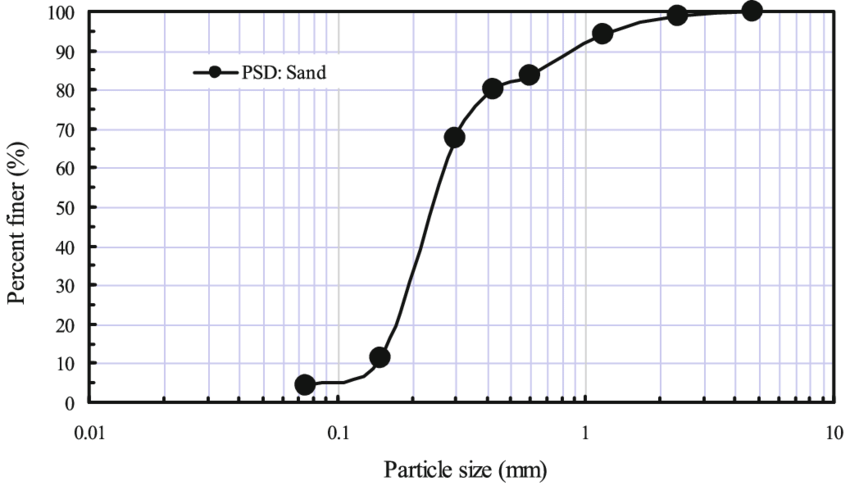
This example allows you to characterize individual soil samples from around the globe. The distribution of particle sizes between soil samples vary greatly based on location of extraction but is an excellent way of characterizing sand.
What is the importance of sand
Sand is important for both industrial and domestic use cases. The industrial uses of sand are among other things construction, asphalt, cement, glass making, foundry casting, abrasives, filtration, manufacturing and fracking. Some of the domestic use cases of sand include; gardening, kitty litter, play sand and home décor.
Related read: Earthquake proofing buildings
To create concrete you need cement, sand, water and rock. One of the most important ingredients in concrete is sand as it serves as a binding agent between cement water and rock to create concrete. The usage of concrete is wide from large infrastructure projects such as dams, highways, skyscrapers and airports until smaller projects such as individual house building etc. In fact the consumption of concrete is enormous throughout the world and is estimated to be around 4.27 billion tons worldwide, see source. This puts sand in high demand across the globe.
Artificial islands
To build artificial islands you need a lot of sand. To build beach nourishments and land reclamation you also require a lot of sand. To incorporate changes in landscapes and road developments you require a lot of sand. These projects all require sand in vast amounts.
As an example consider the recreational beach built as an artificial island off the coast of Amager strand in Denmark. To realize this project contractors needed to use an estimated 1.000.000 m3 of sand. This allowed the creation of an entirely new island for recreational usage, see Figure 4.
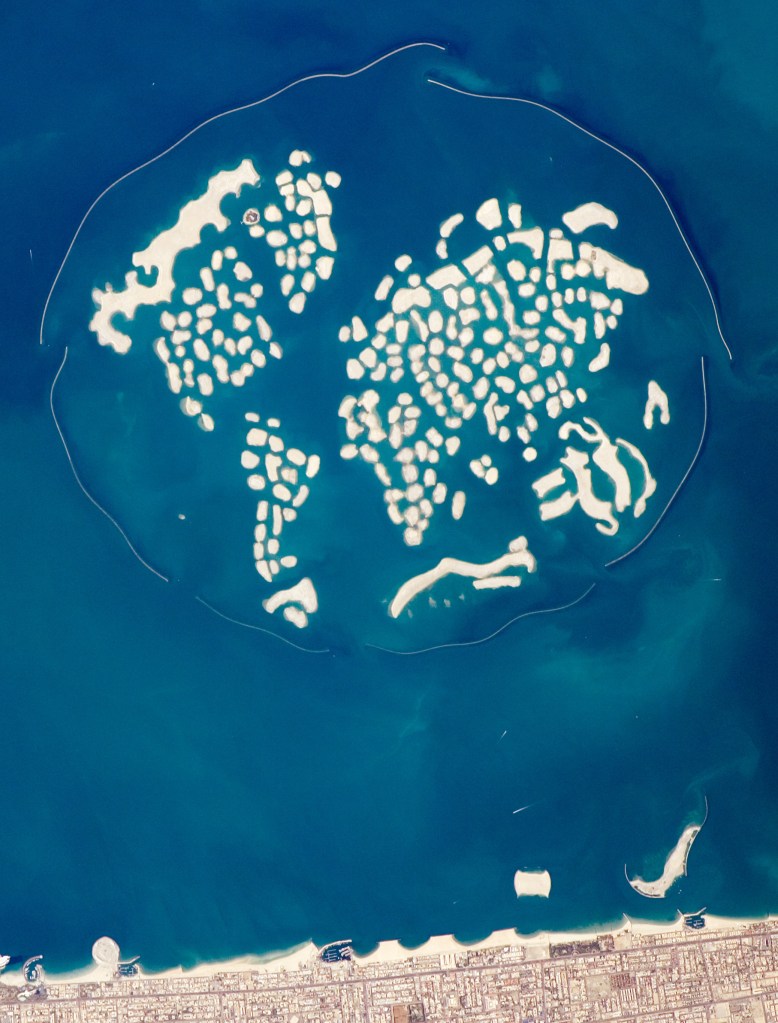
A more famous example of built artificial islands is the “world” located in the northern part of Dubai’s coast. The world is a massive system of smaller artificial islands which when seen from afar correspond to a world map similar to the globe. Estimates show that the amount of sand utilized for building the artificial network of islands in Dubai is approximately 100.000.000 m3 see source and Figure 5.

All of these massive utilizations of sand makes one wonder, is there enough of it to go around?
Can we run out of sand?
Yes, the short answer is yes. However, the type of sand matters. While we can definitely run out of sand used for construction, the answer is more nuanced when considering other types.
In fact, the kind of sand with the perfect grain size distribution for construction is often difficult to find. Consequently, when a usable location is discovered, large quarries are frequently built to extract all of it. Moreover, to ensure access and maximize the excavated amount of sand, people may even be expropriated from their properties if they stand in the way.
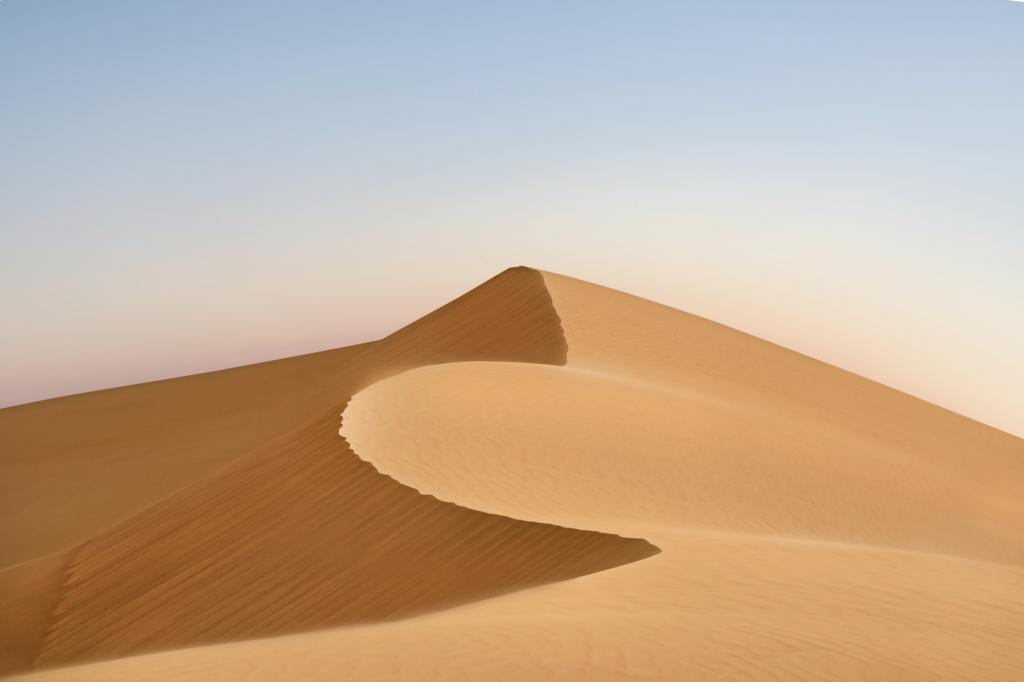
Now one might consider using sand from deserts as deserts, see Figure 6, cover a vast amount of the entire earths landmass. In factuality, experts believe that one-fifth of all landmasses on earth consists of deserts! See source.
Therefore it seems absurd to ask questions like “Can we run out of sand” however the answer is that the vast majority of sand is unusable for practical purposes, unless you want to create a desert.!
The desert sand is useless for building any buildings, infrastructure or mixture in concrete due to its rounded shape and unfavorable grain size distribution. Furthermore desert sand is often times located in remote places where infrastructure doesn’t facilitate the usage of sand.
Conclusion
In this blogpost we have characterized one of the most common soil characteristics – Sand. We have described the name origin, grain size, most common mineral composition, color, hydraulic properties and common usages. Furthermore we have described and debunked common myths in relation to the excavation and usage of sand.
References
General information about sand and pictures Wikipedia
Darcy law equipment source.
Consumption of concrete in the world: finance.yahoo
Sand volume estimates source.
lab equipment – Amazon.com
Desert covering earth, from National Geographic education, source.
Information relating to sieve sizes: Overview: Sieving Analysis in international Standards (labsieves.com)

 The Skjærup blueprint
Leave a comment