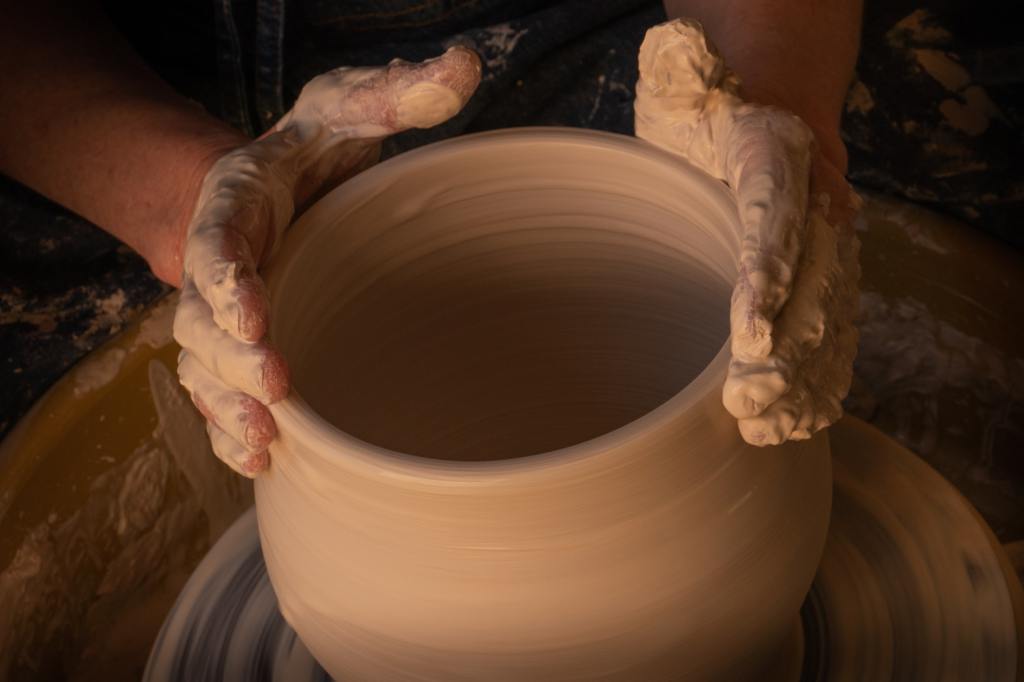
In this blogpost we will explore one of the most common natural materials in the world, clay.
- What is clay?
- Common use cases of clay
- Clay pottery as food storage
- Clay as a building material
- The flow of liquids through clay
- Clay for sculping
- References
What is clay?
Clay is a natural, fine-grained material that smooths out easily under pressure and is often filled with water.
Its composition typically includes minerals like kaolinite. These minerals are essential in the beauty industry, as many common beauty products utilize some form of clay mineral. Additionally, clay minerals are important in certain pharmaceutical industries as binders, lubricants, diluents, pigments, and opacifiers.
History of clay in pharmacy
The use of clay in the pharmaceutical industry dates back to prehistoric eras. It was used in pottery to create containers for medicine, and a “book” from 1600 BC contains evidence of clay being used to treat hemorrhages and other diseases. This underscores the fact that clay has been a crucial part of human society for thousands of years.
Another prehistoric example of clay as a pharmaceutical instrument is found in Hippocrates’ book “On Airs, Waters, and Places,” written in the 400s BC. In this book, he describes the Armenian bole, a special type of clay often used as medicine, a pigment, and a gliding material. Armenian bole is often red due to the presence of iron oxide.
Clay composition
The important compounds of clay in pharmacy is their mineral composition. In order to characterize clay it usually is subdivided into four main groups corresponding to the mineral content. These are:
- Kaolinite
- Smecticte
- Illite
- Chlorite
Where further subdivisions can be made of clay based on the mineral plate layering as outlined in Table 1.
| S. No. | General Formula | Group | Layer Type |
| 1 | Al2Si2O5(OH) | Kaolinite-Serpentine | 1:1 |
| 2 | Al2Si4O10(OH)2Mg3Si4O10(OH)2 | Pyrophyllitetalc | 2:1 |
| 3 | Montmorillonate (Al1.67Mg0.33) Si4O10(OH)2M + 0.33 Saponite:Mg3(Si3.67Al0.33)O10(OH)2M + 0.33 Hectorite(MgLi)3(SiAl)4O10(OH)2M+ | Smectite | 2:1 |
| 4 | (Mg,Fe,Al)3(Al,Si)4O10(OH)2.4H2O | Vermiculite | 2:1 |
| 5 | KAl2(Si3Al)O10(OH)2 | Mica/Illite | 2:1 |
| 6 | Al4[Si8O20](OH)4Al4(OH)12 | Chlorite | 2:1:1 |
| 7 | (Mg,AL,Fe3+)5(Si,Al)8O20(OH)2(OH2)4.4H2O Mg8Si12O30(OH)4(OH2)4.8H2O | Palygoskite-sepiolite group |
Common use cases of clay
Clay has numerous uses and has been used throughout history to create various types of pottery. This pottery has played a crucial role in establishing cultures and societies, as people have produced containers for everything from water to spices.
In modern history, after industrialization, people could mass-produce pottery instead of having individual artisans create it. This freed up time for people to focus on more productive activities like innovation and developing new technologies.
Related read: Soil characteristics – sand, Natural materials – silt
Clay pottery as food storage
Meanwhile clay pottery is still used today to store all kinds of inventory such as food, spices and vegetables. With the advent of vegetarianism it might be reasonable to ask: Is clay vegan friendly? And to that the answer is a sounding yes! Clay is absolutely vegan friendly as the compounds making up clay pottery is entirely from non-animal origins meaning that anything vegan that you put in a clay bowl or pottery stays vegan.
Additionally clay pottery is able to withstand high temperatures and doesn’t decompose easily when burnt. Furthermore the trash from clay pottery is entirely natural and thus no need to worry about environmental hazards from trashed clay pottery.
Clay as a building material
Another use of clay is as a building material for bricks, huts, and similar structures. Here, clay is molded into bricks in huge ovens, where it hardens. When hardened and burned, the resulting bricks are capable of withstanding outside weather, rain, and storms.
Clay bricks for building have been used for millennia, demonstrating the enduring technology of creating bricks from “mud.” The basic recipe for creating clay bricks is simple: Mix water, clay, and straw, then heat it until hardened at high temperatures.
The flow of liquids through clay
Unlike other materials such as sand, clay has a strong adherence to water. It is hydrophilic, meaning most clays absorb water in huge amounts, leading to saturated soils. Additionally, water passes extremely slowly through clay, acting as a plug that stops all water from passing through.
This property of plugging water and other liquid substances from flowing through clay is important in industries such as oil and gas. In fact, clay functions as a lid under which oil and gas collect in huge amounts in large oil reservoirs, often creating the necessary conditions for the existence of oil fields.
The drainage of oil wells is a complicated process that utilizes high pressures to pump water and oil mixtures up to the surface from deep underground aquifers. Here, impermeable layers help build up necessary pressures through overburden stresses, allowing the transformation of organic material into hydrocarbon fossil fuels.
The overburden stressors and impermeable layers can lead to another phenomenon called artesian wells.
Artesian wells
An important consideration when trying to identify potential locations for water extraction is the overburden pressures or internal fluid pressures in underground aquifers. These aquifers allow the flow of liquids over large distances and are typically separated by impermeable clay layers. The impermeable clay layers impose stresses on underlying layers resulting in increased internal water pressures. When trying to extract water from such configurations the resulting pressures in the liquid lead to the establishment of artesian wells see Figure 1-2.
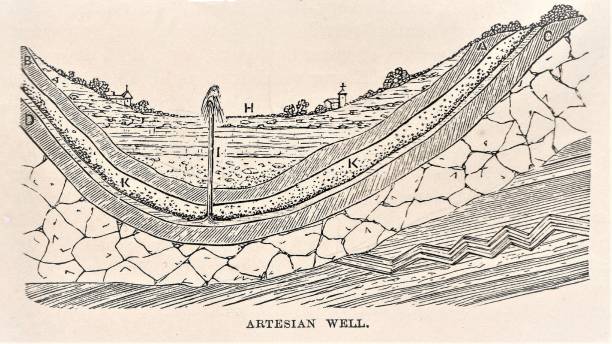
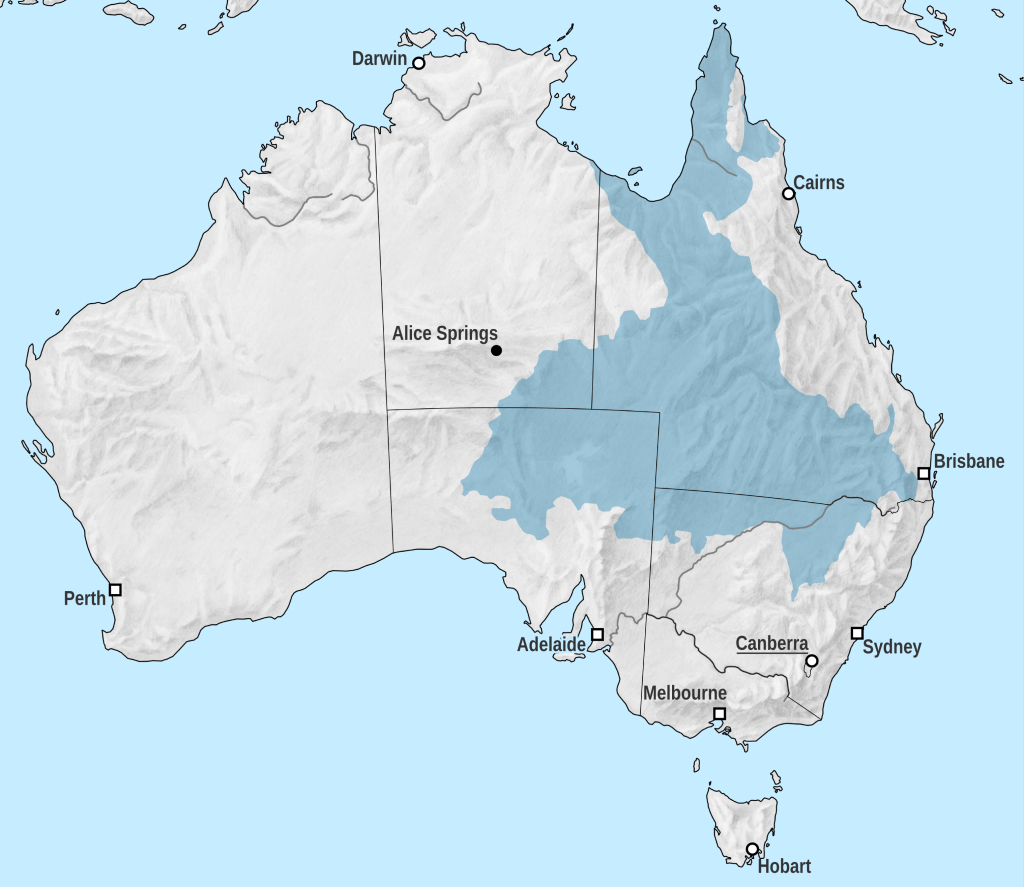
The key defining characteristic between regular and artesian wells is the overburden stresses and internal fluid pressures. these allow for the easy extraction of liquids through since flow is automatic up to the surface meaning no need for pumping systems or otherwise extraction techniques.
Water in artesian wells
Artesian wells often contain water. This water is typically of high quality and easily drinkable as the aquifers functions as filtering material of harmful minerals and bacteria. Additionally water from artesian wells are often free from contaminant sources and thus often bottled as spring water more expensive than regular water from taps, examples of such include Fiji water among others.
Oil in artesian wells
In the beginning of the oil era, artesian wells played an important part for extraction of oil. The flowrate is large for aquifers allowing the extraction of huge amounts of oil and the artesian wells didn’t require expensive pumping instruments.
Additionally the locations of the artesian wells made extraction easily manageable as the land deposits at the time were full of oil. An example of such oil fields are displayed in GIF 1.
The land deposits were furthermore located in locations where large infrastructure existed making the pipeline laying easily manageable. This ensured that oil deposits kickstarted the production of oil in the United States within the first years of industrialization.
Clay for sculping
As a last addition clay is also fantastic for sculping sculptures. For the handy people around these sculptures are easily made utilizing a spinning wheel combined with sculpting clays such as monster sculpting clay.
The monster sculpting clay is exceptional for clay sculpting whether you are a beginner just trying it out for the first time or an experienced professional looking for a hard clay based mounding substrate to easily manipulate into beautiful structures or figures.
References
Mineral composition of clay, source.





 The Skjærup blueprint
Leave a comment