
In this blogpost we outline how engineers have been stabilizing the leaning tower of Pisa. We consider the history, techniques and end-result.
- The leaning tower of Pisa
- The geological composition underneath the leaning tower of Pisa
- The architectural challenges
- Stabilization measures for the leaning tower of Pisa
- Open for public usage
- In conclusion
- References
The leaning tower of Pisa
One of the major problems in civil engineering is getting the foundation of the building correct. Especially when the material which you are planning on building the building on consists water adhesive materials such as silt and clay. The problems with these types of characteristic materials particularly include differential settlement.
Differential settlement of the leaning tower of Pisa
Differential settlement occurs when the weight of a foundation compresses water out of soils that retain a large volume of water. This water doesn’t easily escape from the soil beneath the foundation. The excess pore volumes, filled with water, cause a gradual consolidation of the material over time.
As the foundation exerts pressure, the underlying soil experiences differential settlement. This happens because water is pressed out unevenly across the foundation, leading to variations in the settlement process over prolonged periods.
This causes the building to settle unevenly which in worst cases can form cracks along the foundation and in best situations cause lasting damages to the entire structure.
The geological composition underneath the leaning tower of Pisa
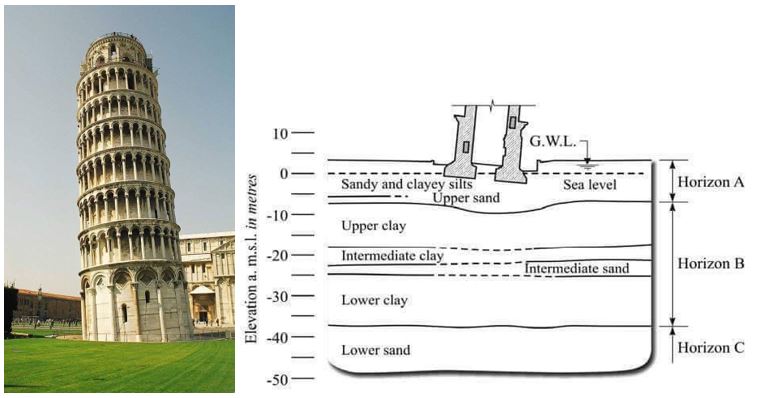
The leaning tower of Pisa stands as one of the most famous examples of differential consolidation. This iconic structure gained its notoriety due to foundational engineering issues, transforming from a source of fright into a cherished historic landmark celebrated worldwide; see Figure 1.
The core ‘problem’ behind the leaning tower of Pisa, is the geological composition and the water tables high occurrence just below the foundation. The sandy clayey-silts which are the main source of concern is located just below the foundation. This particular composition of grain sizes is the root of the differential settlement observed.
The next layers consist of clay, followed by a small layer of intermediate sand and then once again clay. The sand is particularly problematic as water can be pressed out of the clays draining underneath water from clays to the sand content. The flow of water from the differential settlement of the leaning tower structure, allows the compression of the soil layers to easily form underneath the silty clayey top layer. Now to make things worse, the history of the leaning tower of Pisa, makes the stabilizing procedures a lot more challenging.
History of the leaning tower of Pisa
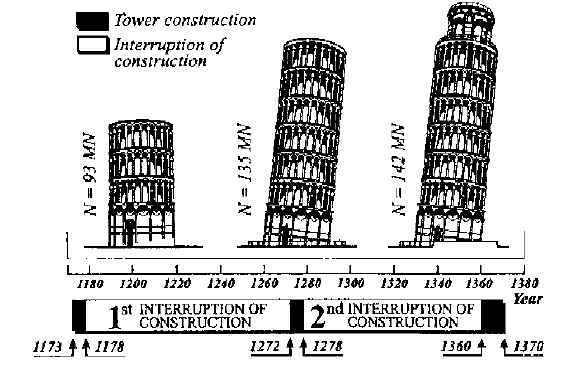
The builders initially planned the tower as a massive construction meant to stand for multiple years. They began constructing the main tower in 1173, expecting to finish later in that century. However, political unrest, recessions, and costly wars forced them to pause construction after completing just four of the eight intended cornices.
Related read: Effective investment strategies for climate adaptation
Financial and political unrest
Macroeconomic tendencies periodically influence middle age construction projects; during prosperous times, developers initiate various projects, while they often cancel or delay most activities during recessions.
The delay in construction of the at the time, Tower of Pisa, was quite significant as compared to similar buildings at the time. The delay was more than 100 years before financial and political stability was sufficient as for the funding of the building to continue onwards.
Related read: Natural materials – silt, Soil characteristics – sand, Natural materials – clay
Second construction period of the tower of Pisa
The second construction period began completing three more cornices of the originally planned eight, before another interruption happened again due to political unrest and financial instabilities occurred.
By this time, excess pore pressures had acted on the geological layers supporting the tower’s foundation for over 100 years, causing the tower to tilt more than any typical pre-consolidation theory would predict.
The now leaning tower of Pisa
Now the builders leaned the tower and continued construction, finishing the last order and top tower cornice. They paused work again due to political and financial unrest, but finally completed the Leaning Tower of Pisa along with its eight cornices.
It thus took almost 200 years from start to finish of the leaning tower of Pisa, a period which by many standards is quite significantly larger than any other major project under construction.
For comparison, the modern day one world trade took ‘only’ 13 years to complete but is simultaneously 104-storeys, 417 m’s high. This is in stark contrast to the 8’th orders corresponding to 57 m’s high leaning tower of Pisa.
For an example of the history of the leaning tower of Pisa, see Figure 3 from [1].
Modern day famous leaning tower of Pisa
The completed tower of Pisa has stood for centuries, enduring without suffering any catastrophic events. As a result, experts have deemed the tilt of the leaning tower of Pisa critical. Moreover, advanced measurement systems monitoring the tower indicate that the tilt is actually accelerating slowly; if no measures are taken, it could lead to catastrophic failures within a lifetime.
Related read: The Atterberg limits: History, evolution and perspectives
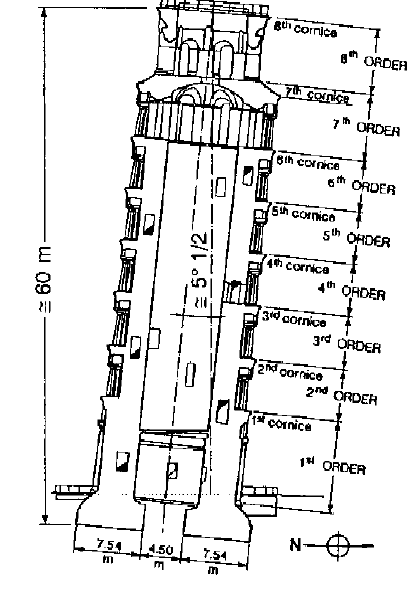
Therefore it was decided to begin stabilization work in the 1990’s. At this point the the tilt was approximately 5.5 degrees, resulting in an overhang of the top cornices with about 4.1 m’s compared to the bottom of the structure, see Figure 3.
Modern day technologies have allowed for the restoration of the tilt ensuring that it is not accelerating as previously experienced. A number of different technologies were investigated. These include; placing heavy rocks on the side of the leaning tower of Pisa’s foundation, placing anchors on the leaning side and installing man pillars on the side of the leaning tower of Pisa.
The architectural challenges
It was crucial not to completely fix the tower’s tilt because it is now considered a historical monument that embodies valuable perseverance.
Additionally, engineers disregarded most proposed solutions, such as installing pillars alongside the leaning tower and adding extra load to the far side, due to their potential impact on the building’s architectural expression and their effect on users.
To address these architectural constraints, engineers opted for an expensive horizontal drilling action. They excavated specific amounts of soil deep beneath the existing foundation, following carefully outlined amounts to ensure sufficient stabilizing actions for the already strained foundation.
Stabilization measures for the leaning tower of Pisa
Most experts discarded the proposed remedies for the leaning of the Tower of Pisa due to its architectural significance. However, some of these solutions proved to be highly successful. The following outlines these measures.
Horizontal directional drilling
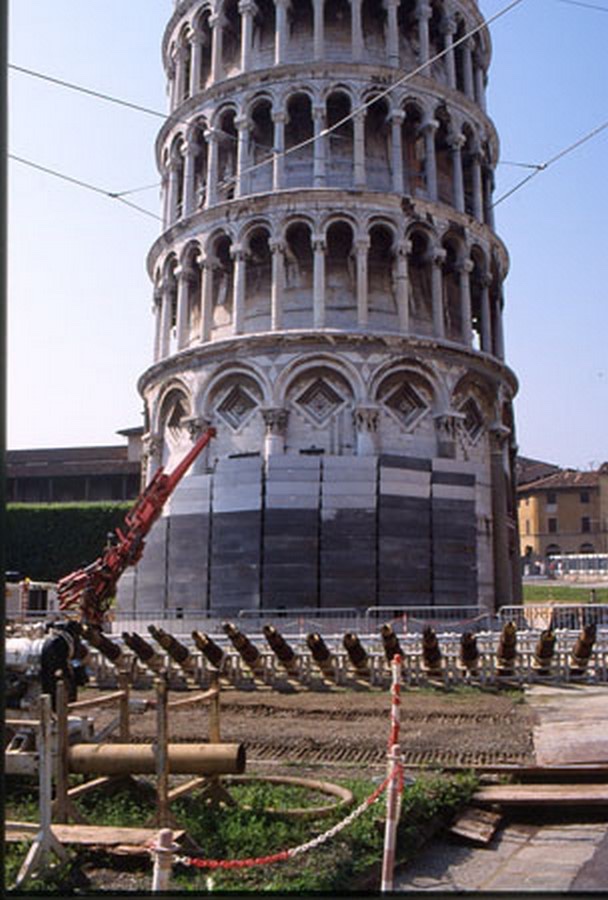
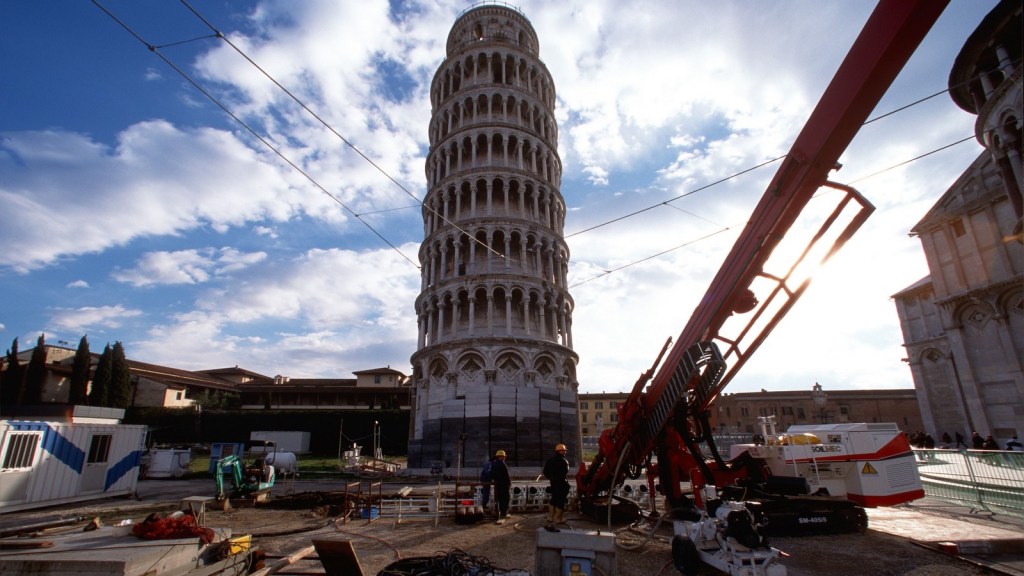
The horizontal directional drilling equipment used for the procedure is illustrated in Figure 4-5. This specialized equipment excaves small, precise amounts of soil deep beneath the foundation.
Additionally, you’ll notice the stones and counterweights positioned alongside the foundation. These counterweights help prevent any potential mis-excavations that could destabilize the entire building, counteracting risks with the combined weight of the blocks and the tower.
This surgical procedure enables engineers and scientists to precisely control the amount of soil that needs excavation before halting the tilt-acceleration.
Drainage of foundation soils
The stabilization of the Leaning Tower of Pisa faces challenges due to the excessive water content in the soil, which initially caused the differential settlement.
Differential settlement occurs when water is pushed out from the inner core samples. This water leaks from the soil because the weight of the entire building compresses the soil, leading to consolidation.
Drain pumps installed
To combat this phenomenon, we installed drain pumps that allow excess water to spill out from the soil and drain away before it causes problems. As the water drains, the soil increases in strength due to compaction and consolidation.
Throughout the entire restoration process of the Leaning Tower of Pisa, the drainage pumps continually pumped water away. This allowed engineers and scientists to easily calculate and ensure safe soil consolidation while keeping the equipment dry during all operational phases.
Cable strays for temporary stabilization
As a final step in the renovation procedures, engineers stabilized the tilt of the Leaning Tower of Pisa using cables.
They wrapped the cables around the structure’s lower decks and pre-strained them, providing the necessary support. This approach ensured that the tower was stabilized enough to prevent any risk of catastrophic failure.
Open for public usage
All the above measures stabilized the tower tilt by approximately 50 cm from the top of the tower. The stabilization efforts ensured that the Leaning Tower of Pisa could safely open to the public after being closed for more than a decade in the 1990s.
The improvements significantly increased the structure’s safety while also preserving the tower’s iconic lean. Authorities deemed a catastrophic failure unacceptable, and they recognized the importance of maintaining the Leaning Tower of Pisa’s distinctive angle.
In fact, experts designed this purposely insufficient recovery of the tower’s tilt to keep the beloved tourist attraction alive while safeguarding its historical value, which has captivated visitors for over 800 years.
In conclusion
Visitors can now climb to the top of the tower and enjoy stunning views of the city of Pisa without fear or concern for their safety. The restoration project preserves the tower for future generations, ensuring that the historical significance of this iconic structure remains intact.
Thanks to the diligent efforts of the team responsible for the stabilization project, the leaning tower of Pisa will continue to lean for many years, captivating tourists from all over the world with its fascinating story and breathtaking beauty.
References
[1] Burland, John & Jamiolkowski, Michele & Viggiani, C.. (2003). The Stabilization of the Leaning Tower of Pisa. Soils and Foundations. 43. 63-80. 10.3208/sandf.43.5_63.





 The Skjærup blueprint
Leave a comment