- Why should I exercise
- Difference between aerobic and anaerobic exercise
- The best exercises for weight loss
- Conclusion
- References
Why should I exercise
Before starting to do any type of exercise you might wonder, why should I exercise in the first place and go through the hassle of getting sweaty and tired.
Well first of all let’s start and consider what type of exercise we are talking about, in this blog post we will consider hard physical exercise, defined by high pressure heart rate typical of running or lifting heavy weights.
Furthermore let’s only consider benefits of effects where you are doing hard physical exercise. The hard exercise thus include two different types of burning process defined as anaerobic and aerobic exercises.
Two major types of exercises
There exists two major types of exercise called anaerobic and aerobic exercise defined by the availability of oxygen in the blood when trying to do work.
But more on this later on, let’s stick to the subject of why you need to exercise, in short here are five typical benefits of hard exercise according to the national health guidelines for Americans: Health.gov see source. The major benefits of regular hard physical exercise are the following:
- Reduction of risk for mortality in general: People who exercise regularly have a reduced risk for mortality in a broad sense meaning that people regularly exercise in a similar manner.
- Reduction of risk for cardiovascular diseases: As you increase your overall metabolic rates through regular exercises the risk for dying of cardiovascular diseases minimizes.
- Reduction of risk for osteoporosis, obesity and cancer: Regular exercise increases the amount of new tissue and regeneration effects of the body through production of
- Increased mental health: The conduction of regular exercise have benefits for the mental health of individuals by reducing the amount of stress experienced while simultaneously boosting self-esteem leading to a more joyous lifestyle.
Regular hard exercise significantly boosts your activity level and offers numerous benefits. If you’re still not convinced, consider this: regular exercise greatly enhances your mental health.
Science answers to mental health linkage
According to the WHO (World Health Organization) mental health branch, 5% of people globally is suffering from the mental health disorder depression.
Depression ranks as one of the most prevalent mental disorders, impacting countless individuals, and its effects can be devastating; the most severe cases may lead to suicide and contribute to various societal issues.
Some of the most common and devastating effects of depression are the following:
- Changes in appetite or weight: Depression can lead to changes in a person’s appetite, which may result in significant weight loss or weight gain. Some people with depression may also experience cravings for certain foods, such as carbohydrates or sugar.
- Feelings of worthlessness or guilt: Depression can lead to feelings of low self-esteem, worthlessness, and guilt. People with depression may feel like they are a burden to others or that they are not good enough.
- Difficulty concentrating or making decisions: Depression can affect a person’s ability to think clearly, concentrate, and make decisions. This can interfere with their ability to perform at work or school.
- Sleep disturbances: Depression can disrupt a person’s sleep patterns, resulting in difficulty falling asleep, staying asleep, or waking up too early. Alternatively, some people with depression may sleep excessively and find it difficult to get out of bed.
These are some but a few of the most serious consequences of depression and as we can see they are quite significant and dangerous which in the worst cases can have fatal consequences for the individual.
Related Read: Earthquakes – Top ten misconceptions, Understanding ChatGPT: The AI Revolution
Beneficial effects to combat depression
Many effective remedies exist for people experiencing depression, and typically, they consist of simple rules that one can follow. Some of these remedies include the following:
- Healthy eating and regular exercise: Improving sleeping habits with early bed and early rising in the morning.
- Medications such as anti-depressives: These might help reduce some of the most serious symptoms of depression such as the suicidal thoughts or sedentary behavior.
- Conversational therapy: Through use of conversations with professionals it is possible to mitigate some of the symptoms of depression as tools and frameworks given by professionals help individuals understand their situation better.
- Support groups: By incorporating within a support group it becomes easier to understand ones troubles and needs which can help comprehend the situation which the individual is stuck within. This also incorporates the need for individuals to feel connection with multiple people.
Individuals can find and follow these remedies for depressive symptoms, which represent some of the most common solutions, although this list is not exhaustive.
Anaerobic exercise
During anaerobic exercises, the body actively prevents the absorption of oxygen. When the intensity of the activity surpasses the available oxygen levels, the body burns calories through non-oxygen processes, which is why we refer to it as anaerobic.
When you perform high-intensity workouts, your body initially burns calories through anaerobic processes, typically lasting from a few seconds to a couple of minutes. This reaction helps the body quickly adapt to sudden environmental challenges.
The key factor here is that the inadequate intake of oxygen, given the demands of high activity levels, triggers specific burning mechanisms in the body.
These mechanisms utilize stored energy in the muscles and tissues, rapidly consumed to power the muscles during this short burst of high-intensity activity.
One important consideration when performing this kind of high intensity workout routine is the increase of endurance. Endurance is the ability to perform and conduct high intensity workout through periods of time during which the experience is somewhat unpleasant.
Aerobic exercise
The aerobic exercises being conducted require significant intensity to effectively burn calories through oxidation.
Like all types of exercise, there comes a point when the body begins to burn calories through aerobic processes, as it pays off the initial oxygen deficit by utilizing aerobic calorie-burning methods.
Healthy oxygen intake
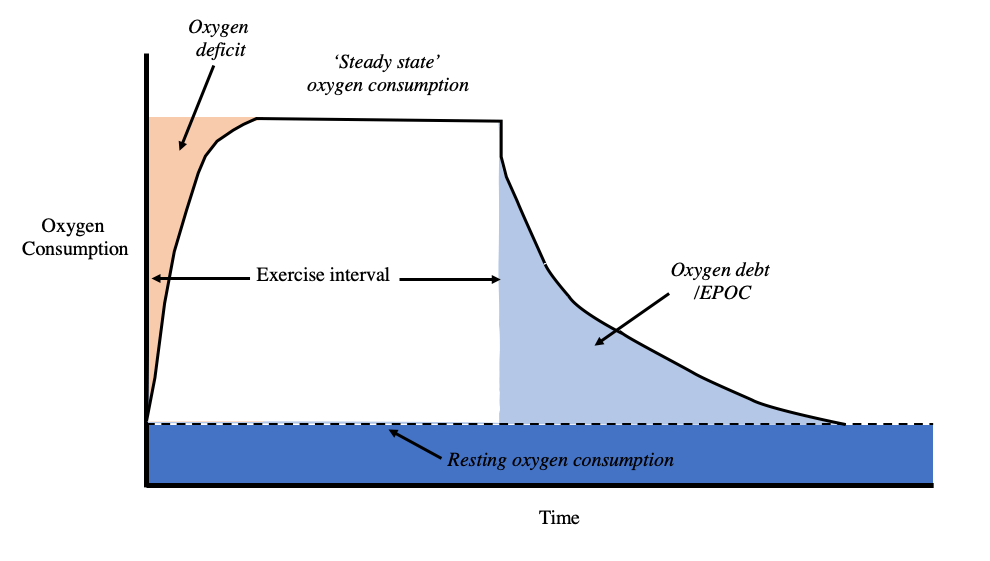
The steady state oxygen consumption rate is related to the heart rate and volume associated with the transport of blood and oxygen through use of the red blood cells. In order to better understand illustratively how the oxygen concentration in the blood varies with exercise an illustration of the oxygen consumption have been made and outlined in Figure 1.
Here we can clearly see the initial oxygen deficit incurring as the amount of oxygen consumed is larger than the oxygen uptake, since the following heart rate increase easily follows that of the oxygen burn rate, we see an decrease in the oxygen benefit with time. This decrease in oxygen deficit is a direct result of the increased uptake of oxygen as the aerobic processes catches up with the remaining needs of the body.
After the oxygen demand decreases, signaling the likely end of the primary exercise, the post-exercise oxygen consumption (EPOC) period commences. During this phase, the body focuses on clearing the lactic acid that has accumulated in the muscles throughout the workout.
To ‘repay’ the oxygen deficit created during exercise, the body engages in increased breathing after the workout, requiring more oxygen to return to its normal state following the heightened activity. Now that we’ve examined the individual processes of anaerobic and aerobic exercise, let’s explore the differences between the two and how each contributes individually.
Difference between aerobic and anaerobic exercise
Now that we have covered both anaerobic and aerobic exercises in detail let’s now try and consider in a chemical sense what makes the two different. In the YouTube video below we uncover the chemical disposition differences between the energy creation from an anaerobic and aerobic process. This way the differences and similarities between the two start to easily unravel.
The creation of energy, ATP, which the body is able to translate into motion of the joints or legs, is what creates the burning of calories and similarly within the body.
This production of ATP is absolutely critical for our warm blooded body as if it wasn’t possible to transform calories into ATP we wouldn’t be here.
The best exercises for weight loss
To facilitate weight loss, it is essential to understand how we lose weight in the first place. You need to burn more calories than you consume each day, so aim to eat less than what you burn to sustain yourself.
Portions are important
This is happening by moving and exercising and watching carefully what you ingest so that you don’t overeat so to say meaning that you shouldn’t eat anymore than you necessarily need to stay warm and healthy.
Therefore in order to start loosing weight an important parameter is exercising more and eating less, it is actually that simple! You need to watch what you eat and make sure that you exercise regularly keeping you in motion, hence burning calories, and making sure that you don’t eat to much.
A 2017 study titled “How does plate size affect estimated satiation and intake for individuals in normal‐weight and larger weight groups?” reveals how plate size impacts portion size and, in turn, the amount of food people consume during regular meals. The study concludes that plate size affects individuals in larger weight categories differently than those in normal weight categories, and that smaller plates tend to encourage people to eat less, which is further influenced by the type of dish and the visual appeal of the food.
Conclusion
Regular exercise offers numerous benefits that are vital for overall well-being, making it difficult to highlight just one reason. However, one significant advantage of staying active is how it effectively reduces the risks linked to depression, such as weight gain, suicidal thoughts, and the ability to cope with environmental stressors.
Additionally, when aiming to lose weight, individuals must boost their exercise levels to maintain a high calorie-burning rate during these lifestyle changes.
References
Peng M. “How does plate size affect estimated satiation and intake for individuals in normal-weight and overweight groups?”. Obes Sci Pract. 2017 Jun 27;3(3):282-288. doi: 10.1002/osp4.119. PMID: 29071104; PMCID: PMC5598018.




 The Skjærup blueprint
Leave a comment