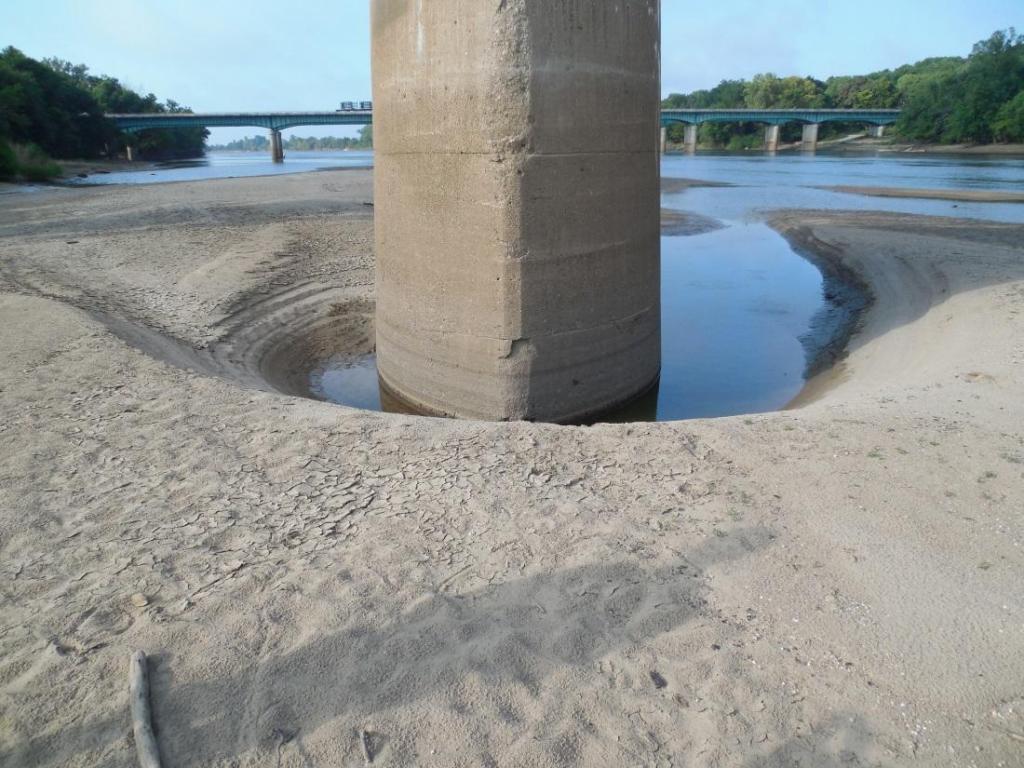
Within offshore engineering there is one phenomena which is widely known, researched and still is a significant issue for the wider implementation of infrastructure, that phenomena is called scour.
Scour is the process of erosion and deposition changes caused by changing flow velocities dragging on the subsurface material causing it to spur up and consequently drift further downstream. The erosion process is highly complex, poorly described and researched intensively for the past century leading to the developing of empirical models describing extent, time dependency and depth of scour holes resulting from both wave and current forcing.
Fundamentals behind scour
The fundamental problem of scour boils down to the interaction between fluid and solid phase materials where in particular granular substrates such as sands is particularly hard to accurately describe as the interconnected processes ranges from small scale fluctuations influencing large scale movements which are seemingly chaotic when observed from a distance.
When particles of different sizes, hardness, smoothness and material composition interact due to the onset of motion caused by the surrounding fluid pressure the resulting movements become chaotic while simultaneously leading to a predictable pattern of drifting backwards due to the vortex induced oscillations happening across a plethora of scales.
The vortexes are transported downstream following the general motion of the fluid caused by external pressures such as tidal motions and wind induced pressures. The combined effect ranges over a broad scale range considering both space and time aspects and how exactly a fluid parcel is influenced by the combined effects are not yet understood completely.
However for the vast majority of engineering projects we are reliant on previous research projects results and their applicability in areas where limited availability of information persists. This means that the individual instances of scour protection and methodologies to mitigate long term effects are difficult to thoroughly understand.
Scour feedback mechanism
The development of scour is time dependent starting out with a small amount of particle movement further increasing the velocity distributions meaning that essentially a feedback mechanism exists, where individual particles move leading to increased areas where fluid velocities can increase further and subsequently introduce further erosion.
This feedback mechanism is one of the reasons why the scour process is so inherently difficult to accurately describe as the complexities are compounding and the resulting time-frequency of things are difficult to frame properly within the physical and mechanical constraints of modern day engineering.
Furthermore, when currents change due to tidal movements, we end up having the hole which have been created being subsequently filled up again to the brim and new erosion patterns developing backwards of the monopile or cable in question.
This back filling process is key to remember and not neglect. The reason for this is that once the hole is filled up and the newly hole starts to form, the previous perimeter of the scour hole is deconstructed and slowly transformed in the opposite direction, however as the newly hole starts scour hole evolves, the previous perimeter influences and enhances the depth at which the erosion holes can develop. This interchangeable dynamic has a negative impact on the structural integrity in question as the individual contributions towards scour enhances the equilibrium and maxima scour depths possible.
These feedback processes are important to consider but hard to study in-situ, as the processes are highly site dependent, meaning that the individual fluid and wave properties are difficult to understand individually not to mention in cases where combinations should be considered. This means that for the majority of cases it is necessary to conduct empirical tests in wave and current flumes for scale replicas of the final design considerations.
Empirical scour design
Since theoretical progress on specific designs of breakwaters are difficult to come by and more importantly almost impossible to utilize for practical designs the engineer and designers will have to resort to empirical methods either through the construction of small scale replicas or utilize scientifically empirical relationships between different types of rock embedment or similar types of constructions where empirical relations have been established.
This resort towards empirical designs create opportunities for scientists and engineers to carefully consider differences between the individual contributions towards the scientific knowledge base. Through these types of empirical relations it becomes easier for the general public to create increasingly complex structures based on the experiences from previous generations. This is one of the essences between modern engineering practices, creating a foundation for future generations to prosper based on the learning from previous generations.

 The Skjærup blueprint
Leave a comment