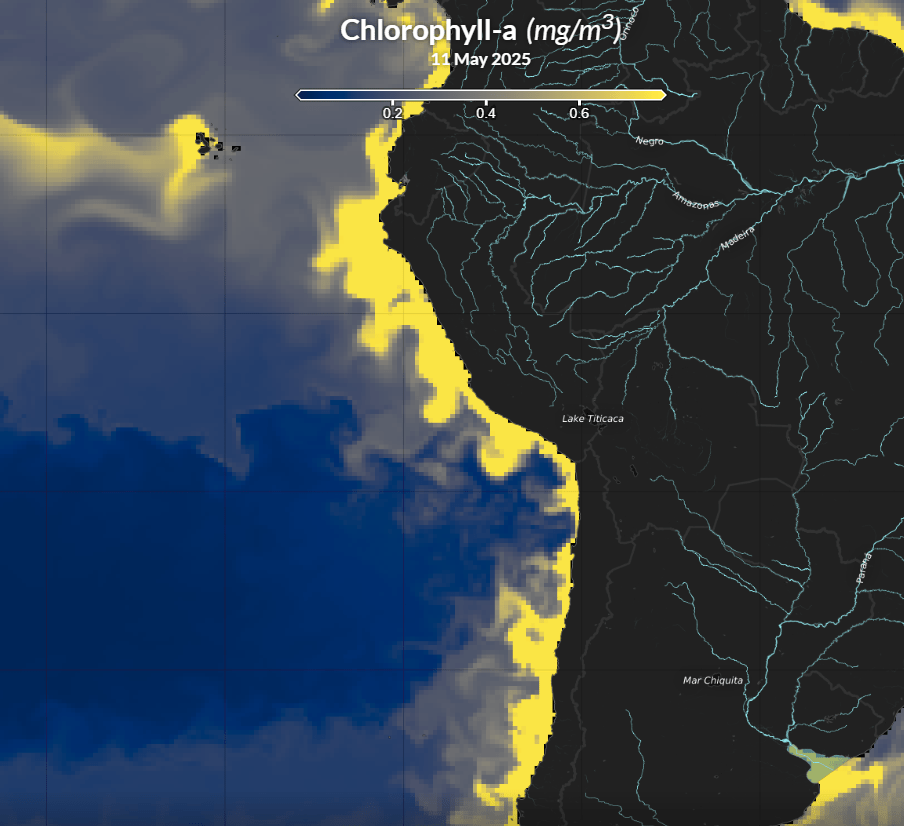
The Humboldt current is an important driver of life across broad scales from micro ecosystems until vast ocean systems interconnected across species and vast distances.
Some of the aspects important from the Humboldt current includes the availability of fish livestock, the inhibition of cyclone formation and availability of nutrients for sustaining marine life. In the following we will take a deep dive starting with an overview and introduction followed by significant effects, importance and finally looking into some perspectives of the Humboldt current.
- Introduction and overview
- Potential future scenarios
- Perspectives to human made climate change
- References
Introduction and overview
The Humboldt Current, also known as the Peru Current, is one of the most important ocean currents in the world. Flowing northward along the west coast of South America, from the southern tip of Chile to northern Peru, this cold-water current plays a vital role in shaping the climate, marine ecosystems, and even the economies of the countries it touches.
The Humboldt Current is a cold, low-salinity ocean current driven by the southeast trade winds and the Coriolis effect. It originates in the Southern Ocean and hugs the South American coast, bringing nutrient-rich waters up from the deep through a process called upwelling.
Upwelling happens when cold waters are forced upwards in the water column transporting nutrients and salt into important parts of the water column containing a broad variety of marine life.
These upwellings help keep a foundation of abundant life sustainable and encourages the creation of one of the richest marine ecosystems on Earth. As the figure below illustrates, there is a massive amount of nutrient rich water which is being transported and carried upwards through the water column alongside the coasts of Peru and Chile, this is exemplified and observed through hindcast numerical modeling of the oceans quantifying the effects and upwelling intensity across the coasts.

The marine life is flourishing as a result of the mixture of cold and hot water alongside with the introduction of nutrient rich waters in otherwise nutrient poor environments. This combination leads to a boom in the pelagic marine life while simultaneously supporting a wide variety of marine plant life as well as the most important parameters of the nutrients are effectively transported towards the microorganism which are reliant on them.
Why is the Humboldt current important?
Marine Productivity thanks to the Humboldt Current supports massive populations of plankton, which are the foundation of the marine food chain. This makes it one of the most productive fishing areas in the world, especially for anchovies and sardines. It is crucial for the continual contribution to nourishment for the marine ecosystems.
Furthermore, It also plays a key role in moderating global temperatures and contributes to weather patterns, including El Niño and La Niña phenomena since the introduction of the colder waters along the shores are transported towards the beginning of the cross pacific currents responsible for such weather effects.
However, another quite important characteristic of the Humboldt current is how it stops and helps store carbon dioxide within the deep ocean basins across large scale formations. This is the direct product of the complicated ocean dynamics governed by temperature, salinity and general astronomical effects responsible for driving some of the immensely important currents across the globe including the Humboldt current.
Carbon sinks in oceans
Its role as a carbon sink is important since the production of oxygen and subsequent absorption of carbon dioxide are significant for the ocean currents including the Humboldt Current and plays a large role in the global carbon footprint for the entire globe. Thus, its acidity and production of phytoplankton is crucial to monitor in an effort to understand the evolution of the carbon dioxide sinks.
Especially since the industrial age, where human made contributions towards climate change is increasingly apparent and subsequent environmental changes slowly are uncovered.
These changes are initiated through the excessive increase in carbon dioxide emissions from a variety of sources including combustion engines, coal powered power plants and other electricity generation sources stemming from oil, gas and coal.
Policy makers and importance of human impact
The understanding of carbon sinks in the ocean has never been more important to thoroughly investigate and understand ensuring that all the fundamental mechanisms behind the carbon cycle is understood thoroughly and uncovered in a manner which allows policy makers and powerful politicians to incorporate laws changing the human impact of the carbon footprint of human activities.
These fossil fuel emissions are the primary challenge which the human race is facing for the coming century and is to be tackled through use of a broad variety of technologies including the introduction of electric powered vehicles, renewable energy sources and general decommissioning of existing types of fossil based energy sources.
These challenges will take a tremendous amount of time, effort and ingenuity to efficiently solve and require international collaborations between states, countries and research institutions before a wide variety of solutions and actions are available for the broader public.
Now back to the Humboldt Current and some of the benefits which it brings along with it not only the individual productions of phytoplankton and salinity varieties, also the shielding effects from catastrophic events such as cyclones and hurricanes, a subject we will touch upon in the following.
Inhibiting formation of cyclones
The Humboldt current is an important contributor alongside with the trade winds present alongside the Peruvian coasts to the inhibition of cyclones and hurricanes. This unique combination of cold water and cross-shear winds ensures that cyclones are not forming outside of the coasts of Peru meaning that they are sheltered from such potential catastrophes which are afflicting in particular the Japanese and Taiwanese coasts. This effect is clearly visible when looking at the occurrence map of the number of tropical cyclones happening across a broad variety of scales.
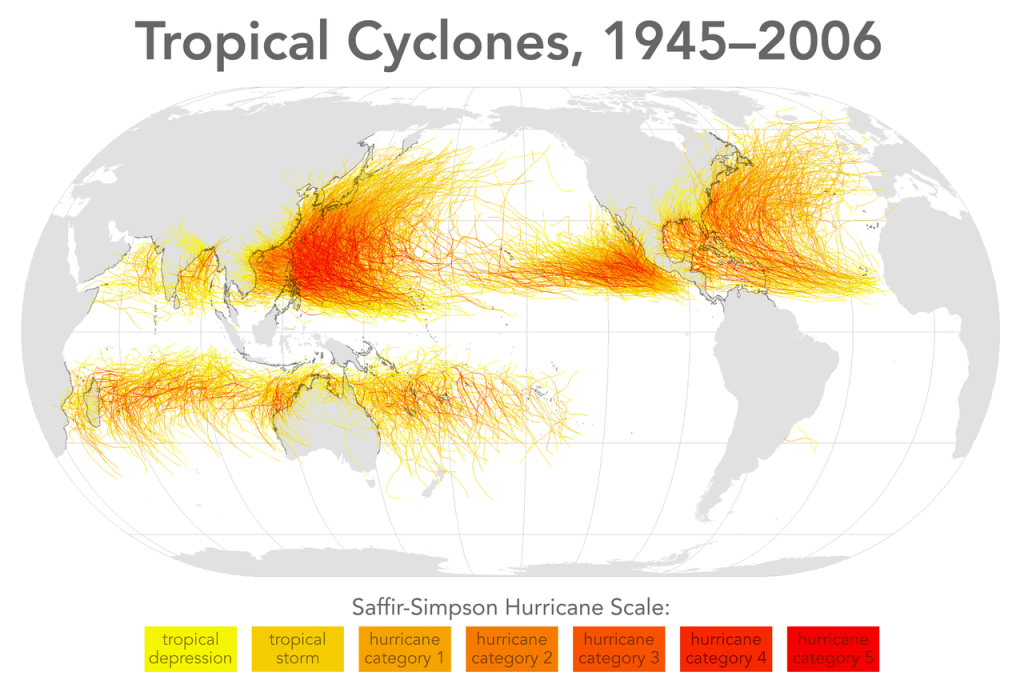
As we can see, the wide occurrence of high intensity tropical cyclones across the map are particularly present on the eastern coast of USA and the eastern coast of Japan leading to massive destruction and socioeconomic losses every year, however the Humboldt current is a major factor ensuring that such formations are not present across the coast of Peru. How exactly cyclones and hurricanes are formed are not the topic of this blog post however to put it simply, hot water is an important prerequisite for the formation of the destructive phenomena and helps fuel the wind speeds and precipitation which are characteristic for such occurrences.
Since the flow of hot and cold surface waters is such an important contributor to the formation and intensity of storms, the well known meteorological formations of the El Niño and La Niña phenomena are often tracked intensely in an effort to understand exactly how ‘bad’ the upcoming hurricane and typhoon seasons are going to get.
Surface currents and El Niño\La Niña
In short, the two current phenomena, corresponds to a warm and cold surface current anomaly which are happening across the entire vast sea of the pacific ocean. Thus, these currents are effectively transporting immense amounts of energy across the pacific towards the eastern coasts of the countries of Asia.
During the hot, El Niño, phenomena, the resulting increased water temperature of the surface water lays an increasing foundation for the upcoming hurricane and typhoon season, while a La Niña event will work opposite, reducing the potential intensity of the upcoming hurricanes and typhoons.
Since the origin of these two surface current events is across the south American peninsula, the Humboldt Current directly influences and fuels the first parts of this massive system of currents, inadvertently influencing their corresponding magnitudes.
This is one of the most important examples of how the Humboldt current is influencing the everyday life of the Peruvian and south American people although it is invisible to everyday individuals.
Potential future scenarios
The introduction of increased levels of green house gasses (GHG), can subsequently influence the ocean dynamics through a variety of effects, some of the most important ways which influences the current circulations such as the Humboldt current, is the desalination of oceans through introduction of increased amounts of fresh water from glaciers in the north and south-poles respectively.
One of the fears is that this introduction will alter circulation patterns of current oceans, including the Humboldt current, leading to rapid changes in both marine life and subsequent weather patterns in local areas, while also posing a threat due to increasing sea levels across the globe.
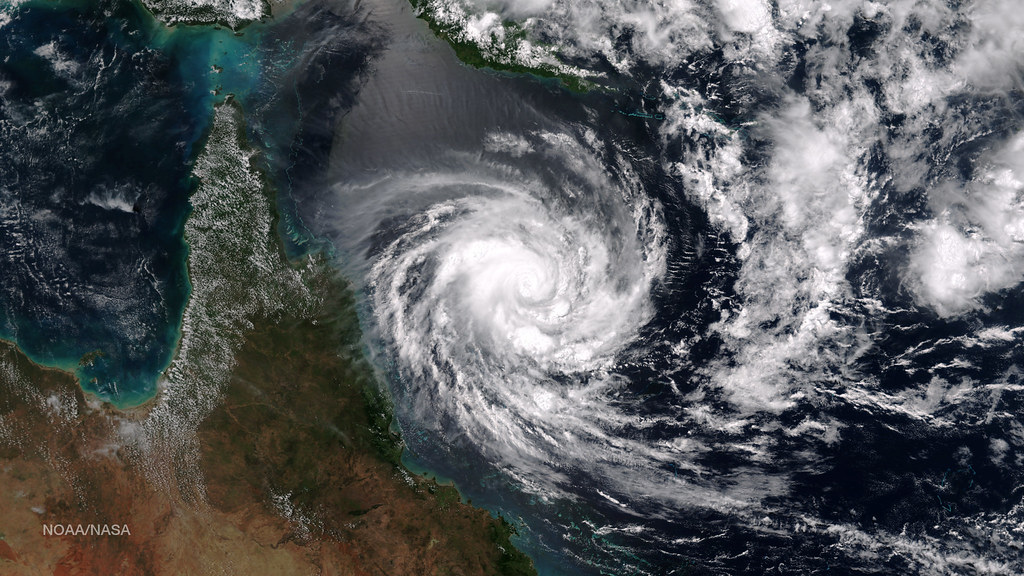
Related read: Tropical Cyclone Alfred hitting Australia’s east coast, Debunking Earth’s Shape: Sphere vs Flat Earth.
This possible change in temperature and salinity leads to a broad scale change in the way that currents may bend and flow. A foundational aspect of marine and mammal life across the globe and also a critical aspect to cities of the futures, where most of these are located in areas close to the sea. This would also influence one of the most important properties behind the Humboldt current, the production and degradation of Phytoplankton.
The role of phytoplankton
Phytoplankton is the main food source for the lowest marine life in the food chain supporting a broad range of all marine life. Furthermore it is responsible for a significant amount of the oxygen produced in the worlds oceans and acts as a carbon sink as previously outlined. However, sometimes it can be detrimental to the worlds ocean life particularly when blooms occur leading to a broad range of catastrophes from typical algae intrusions that are toxic towards hypoxia events when these degrade and use up all the available dissolved oxygen.
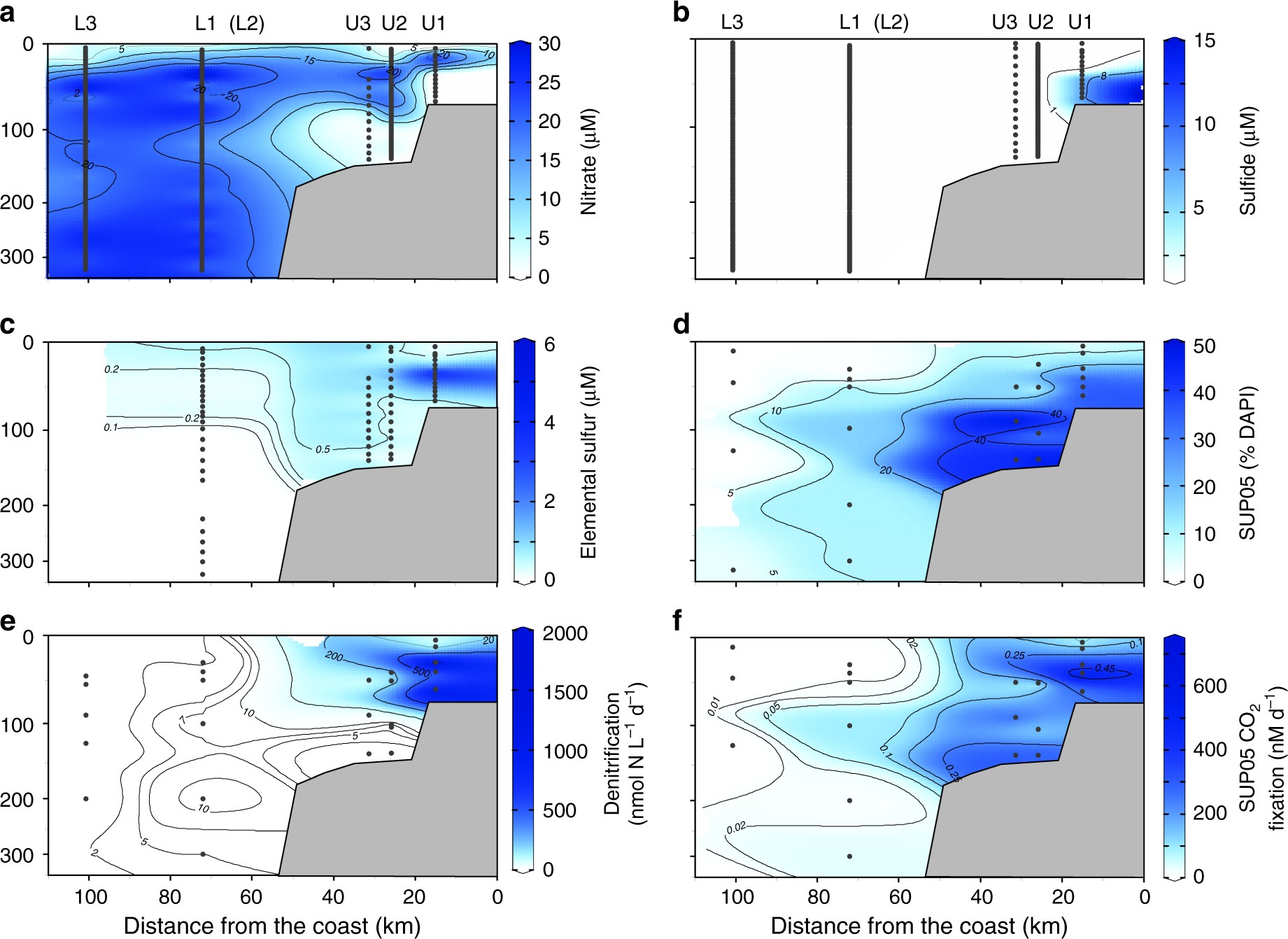
However, it is worth noting that, in general, phytoplankton is benefiting the general ecological status of the marine wildlife. Its role in sustaining marine life is critical to understate as it is the foundational food source for the smallest organisms which are lowest in the food chain.
Thus these fish and crustaceans who are benefiting from eating the smaller animals, form the basis for other larger species of mammals and so on and so forth. Therefore a thorough understanding of the dynamics of phytoplankton both concerning transportation and production is something which researchers and scientists are trying to understand.
Related read: Impact of Ocean Currents on Marine Ecosystems, Environmental impact of offshore infrastructure
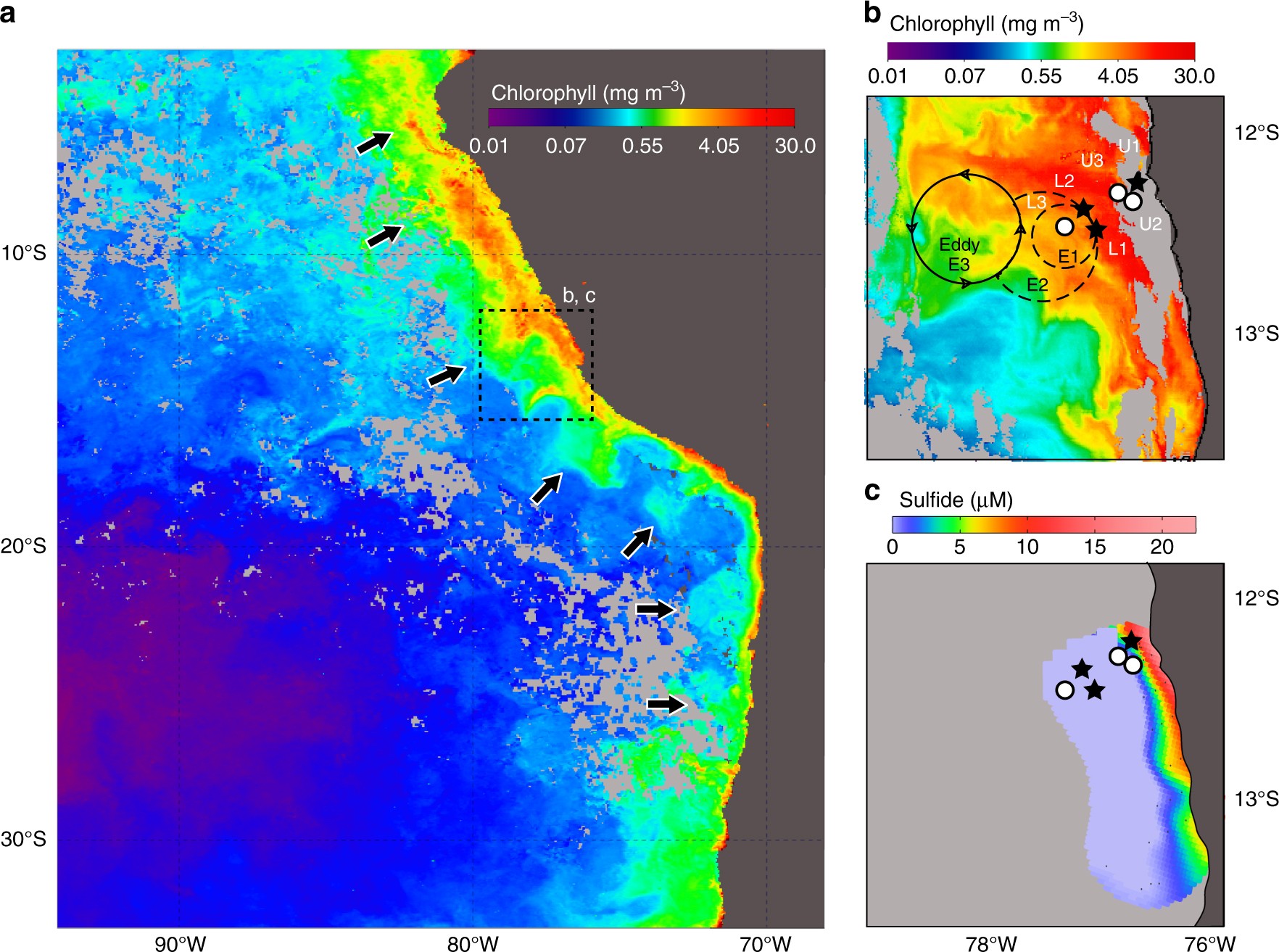
Now in order to accurately quantify and understand the upwelling effects of nurtured phytoplankton, researchers have conducted advanced numerical modeling and statistical analysis in order to better understand the Humboldt currents effects on local communities. They are also tasked with understanding the spatio- and temporal effects following from climate change related phenomena specifically attributed to the human made component.
Mixed layer depths and seasonal dependence
In order to quantify and understand the production and spatio-temporal distribution of primary production of phytoplankton, researchers have conducted a high resolution study of the numerical dependence of the mixed layer depths alongside the correlation of a wide variety of parameters considering both nitrate, sea surface temperature, mixing layer depth, nitrate and chlorophyll.
They investigated the near-shore dynamics and considered the yearly variation of these parameters comparing both insitu observations and model output. By utilizing the Taylor diagram for quantifying dependencies and correlation between model output and observations they elucidated that the model domain output fit reasonably well and within acceptable standard deviations with minimal root-mean-squared-error to the observed measurements in the ocean, thus providing credibility to the model outputs. These model outputs are therefore available for further interpretation and analyzed without conducting significant errors based on the data available.
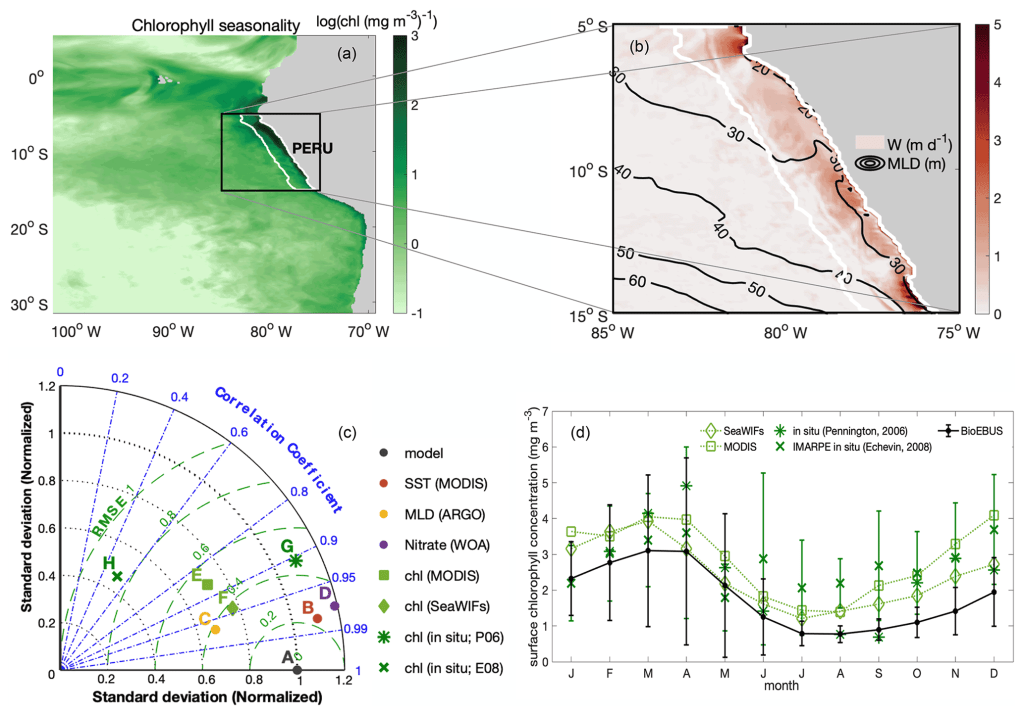
The important mixing layer depth variation across the year is also a parameter worth investigating, as the phytoplankton production is happening in the upper layers of the ocean, where salinities are lower compared to high salinity flows in the bottom layers. Furthermore the mixture of low and high temperature flows is unnatural since naturally these two have a tendency to stay separated due to cold waters flowing downwards and warm waters flowing upwards, so-called buoyancy changes with density and temperature.
This leads to the effect of the mixture depth outlining a clear line between the two layers of fluids and the depth associated with the warm productive layer of phytoplankton. This causes a broad and distinct change in distribution of concentration in nutrients and subsequent phytoplankton. It is therefore of critical importance to understand and study the effects of such mixing depth layers which has lead researchers to question the distribution and temporal evolution of phytoplankton concentrations across the year and along the depth for a critical cross section of the coast in Peru.
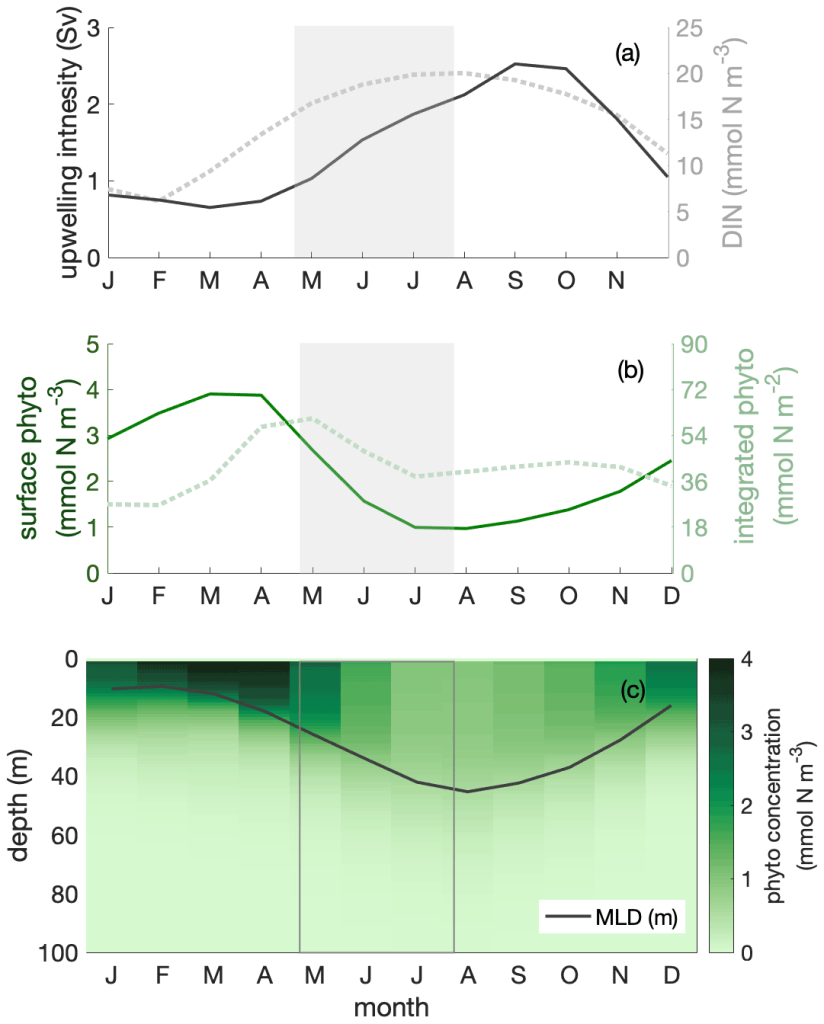
As is elucidated from the figures the primary production of the phytoplankton and other nutrients are in the south hemisphere summer months in a smaller depth compared to the depths of the cold months. This change is critical to understand as the mixing length is governing this interaction and subsequent living foundation of the micro organism. However in certain cases, it is also responsible for a massive blooming of algae, so-called algae blooms.
These types of algae blooms are important as they are producing a vast amount of marine death and can cause hypoxia events, especially in vulnerable shallow water areas and bays. Hypoxia events are cases where all the dissolved oxygen is used up degrading the organic material in the surface. A particular instance is that recent research show that the Paracas bay is a highly vulnerable area which occasionally is subjugated to hypoxia related events.
Risk of hypoxia events
This led researchers to ask the question whether the oxygen rich waters across the coasts of Peru is changing with time due to changes in the phytoplankton and occurrence of Humboldt current upwelling events?
To elucidate this question research have been conducted on a long time series based on validated hindcast evaluated model output from the past decades. Afterwards depth dependent model output has subsequently been analyzed in an attempt to try and understand the dynamical system changes across the water column, as a result of interactions across the broader water depth.
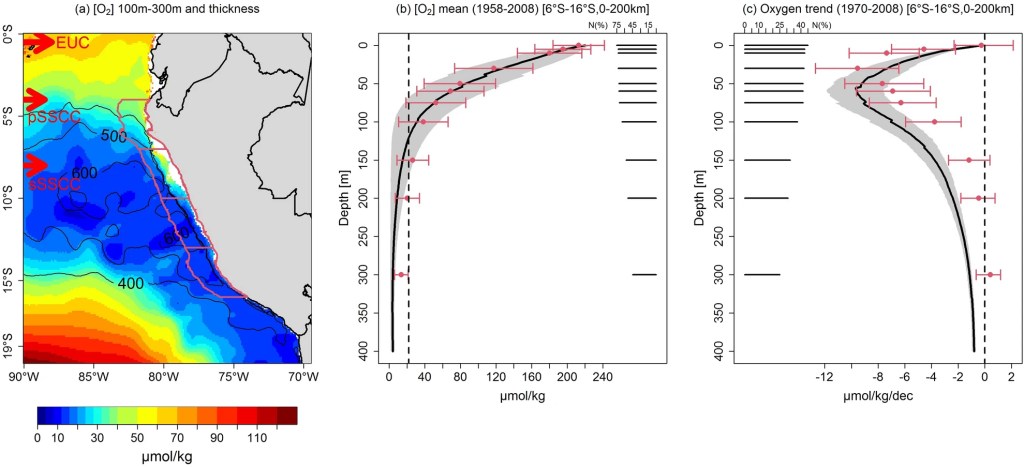
As can be seen from the figures, the concentration of oxygen is quite low compared to the general ocean quantities when looking across the Peruvian coast. This is a direct result of the transport of low salinity, cold water and blooming events caused by algae formed from the introduction of nutrients across the water column.
In particular, from viewing the trends in oxygen dissolved in the water column it is seen that especially along the area of the mixed depth layer, (layer where primary production of phytoplankton occurs) is particularly hard hit from the change in dissolved oxygen during the past decades.
Related reads: Environmental impact of offshore infrastructure
Thus, it is seen that the mixed layer depth, which is sensitive to changes in general sea surface temperatures, SST, and general upwelling events, is highly influencing hypoxia risks in bays, harbors and shallow water areas and that such events are potentially more common in the future as a direct result of the decrease in dissolved oxygen across recent decades. Thus the effort to combat human made climate change is also a question of oxygen available for the animals of the ocean.
Perspectives to human made climate change
This is just one of the niche areas of our environment which is seen to be influenced by the upcoming change in temperature across the globe, however it is a good example of how the complex interconnected drivers and dynamics considering both marine life, temperature, salinity and current strengths evolve with a changing climate and can lead to harsher conditions for the general marine ecosystems to endure.
These contributions from human made environmental changes show efficiently how the individual contributions from international communities have cross-border consequences, in far reaching areas seen from a point of pollution.
The fundamental challenge facing human kind is thus not only of societal importance, it is ecological importance as well. Especially considering that ecosystems are incapable of fighting or combating these human made changes on their own and are instead forced to adapt to these rapidly changing environmental tendencies, such that they does not succumb to the combined pollution of the human made contributions.
This calls for humanity to step aside differences in culture, color, race and socioeconomic status and instead work together on long lasting solutions transforming our societies into a renewable form, remembering to account for changes in habitats we are not necessarily interacting with on the daily. Especially when considering so vast and important environmental factors such as the Humboldt currents.
References
Du, T., Wang, S., Jing, Z. et al. Future changes in coastal upwelling and biological production in eastern boundary upwelling systems. Nat Commun 15, 6238 (2024). https://doi.org/10.1038/s41467-024-50570-z. https://rdcu.be/ek7J7
Xue, T., Frenger, I., Prowe, A. E. F., José, Y. S., and Oschlies, A.: Mixed layer depth dominates over upwelling in regulating the seasonality of ecosystem functioning in the Peruvian upwelling system, Biogeosciences, 19, 455–475. https://doi.org/10.5194/bg-19-455-2022, 2022.
Espinoza-Morriberón, D., Echevin, V., Gutiérrez, D. et al. Evidences and drivers of ocean deoxygenation off Peru over recent past decades. Sci Rep 11, 20292 (2021). https://doi.org/10.1038/s41598-021-99876-8
Callbeck, C.M., Lavik, G., Ferdelman, T.G. et al. Oxygen minimum zone cryptic sulfur cycling sustained by offshore transport of key sulfur oxidizing bacteria. Nat Commun 9, 1729 (2018). https://doi.org/10.1038/s41467-018-04041-x
 The Skjærup blueprint
Leave a comment