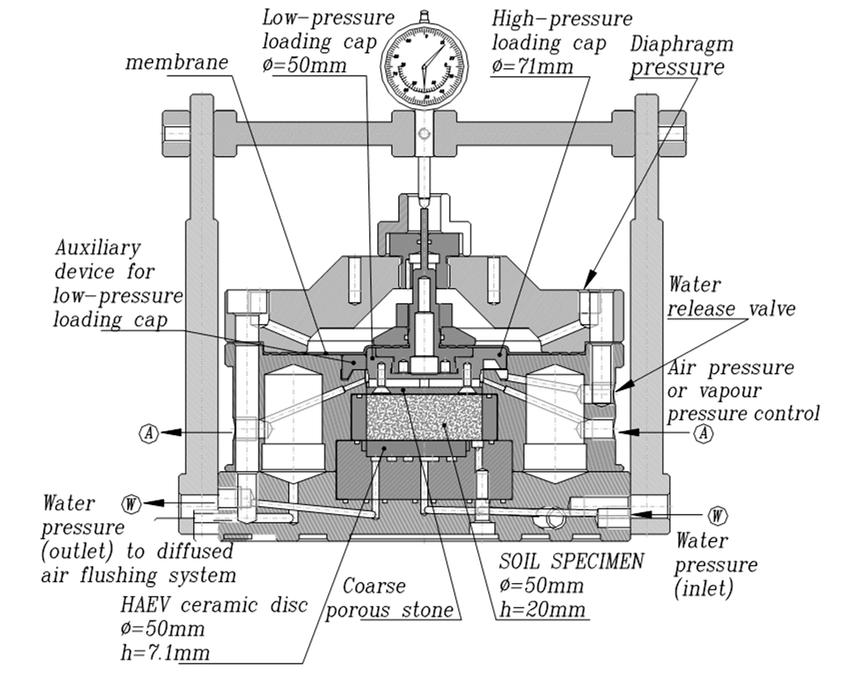
In this blogpost we elucidate the different characteristics about consolidation test including the knowledge gained from performing the test under various different conditions.
We begin by exploring the history of the test, then we delve into its various methodologies and perspectives, discussing what it can achieve and its limitations.
- History of the consolidation test
- The use cases of consolidation test
- Creep – Second order consolidation
- Perspectives
- References
History of the consolidation test
The consolidation test emerged in the early 1900s, developed by the French inventor Jean Frontward, who created an oedometer to measure pressures from various soil specimens. By sampling these pressures from a larger soil medium, engineers can accurately characterize differences on a broader scale. Understanding the variations within soil specimens is essential, as any inaccuracies can lead to significant errors when interpreting the overall soil medium.
The oedometer enables the measurement of soil deformations under different strain rates and loading capacities. Its invention has become a cornerstone of modern geotechnical engineering. Now, let’s explore how the oedometer operates and is used to establish loading histories of soils.
The oedometer
To develop oedometers effectively, researchers crucially included variations found in soil specimens. They replicated soil samples across various oedometers, enabling comprehensive testing of different soil strengths and providing a holistic view of the characteristic strengths associated with soil pressure history.
Before the digital age and the advent of digital computers, users could operate multiple oedometers in parallel, allowing for straightforward access to strength measurements through controlled experiments.
The parallel loading sequence across different intervals is vital because the continuous strain variations under diverse loading conditions reveal how the earth has been previously stressed. This history may reflect periods such as ice ages when large ice shelves exerted overburden stress or instances where the soil is encountering pressure for the first time. For an illustration of a testing rig featuring multiple traditional oedometers, refer to Figure 1.

By enabling measurements of displacements for loading scenarios it was possible to start the process of theorizing how soils behave under a variety of scenarios.
Consolidation curves
The loading histories established from measurement readings of the oedometers’ linear vertical actuators reveal distinct strain patterns based on the applied pressures, allowing us to interpret soil behavior across stress ranges. For instance, Figure 2 illustrates a consolidation curve with re-loading branches that demonstrate soil behavior under various loading conditions.
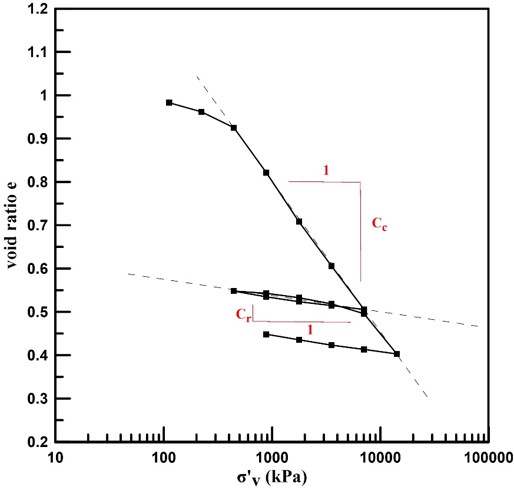
Although beautiful, it is important to recognize that numerous methods and methodologies exist to determine the consolidation pressures typically found in specific soil samples, as the curvature of the calculated pressures changes rapidly around the so-called pre-consolidation pressures.
Pre-consolidation
To understand exactly what a pre-consolidation pressure is, it is important to realize the highly non-linear behavior of soil strengths and how the pressures exerted on the medium inherently changes the responses of the soil, unlike other types of phenomena known from the steel and materials world.
This non-linearity prominently appears in the section of the curve where soil pressures change rapidly, leading to a linear response on a log scale. Additionally, researchers actively investigate how to determine the consolidation index using the time-response of a specific soil medium.
Theorizing soil behaviors based on consolidation curves
The soils under testing in the odometer was able to drain and carry different loading conditions at each stage of the loading leading to the incremental loading conditions which we also know from modern loading scenarios and odometer tests.
This pioneering groundwork leads to Karl Terzaghi who in 1919 began research on the consolidation theory of soil matter. This leads to the published theory of consolidation from 1923 which is the birthing of a new branch of geotechnical research that has since been instrumental in the development of the modern world of engineering. For a portrait illustration of Karl Terzaghi, see Figure 3:
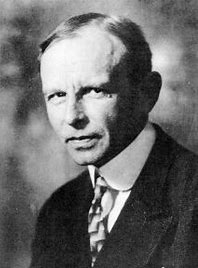
Karl Terzaghi’s groundbreaking footwork remains widely used today, providing a foundational framework for developing further theories that are essential in tunnel industries, construction facilities, and similar projects.
Related read: Natural materials – clay, Understanding clay characteristics across Denmark
Effective stresses play a crucial role in modern geotechnical engineering. Understanding how water interacts with the earth is vital, as the soil structure is necessary for creating a comprehensive theory that addresses the differences within.
Stresses in a soil medium
Before advancements in soil theory and the understanding of concepts like effective stress, geotechnical engineering primarily arose from experimentation with natural slope stability and the specific weights of soils. This experimentation has significant implications for landslide phenomena and settlement issues that have plagued humanity for centuries.
In the 1717s, French engineers proposed theories regarding the overturning of piles, which led to the creation of early design features for retaining walls. These walls were constructed using semi-empirical methods that helped determine the first angle of repose.
The angle of repose is crucial for slide stability, especially in the mining industry and in sand and gravel operations. This angle serves as a key characteristic in stability calculations, proving particularly useful in quarries and similar settings.
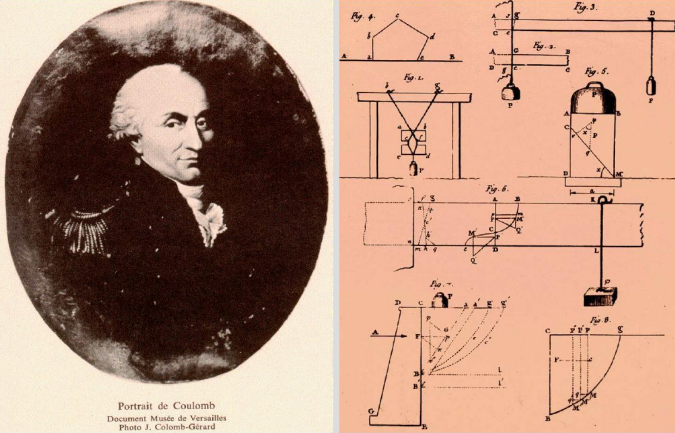
The initial theoretical foundations of soil strength characteristics originated from Charles Augustin Coulomb’s development of Coulomb stress measures, which predated Terzaghi’s advancements in effective stress theory.
The discovery of effective stresses
One of the most significant findings from the consolidation theory emphasizes the role of effective stresses, which are essential for understanding the intricate and complex interactions between solid and liquid, particularly in smaller scales found in clay, silt, and similar mixtures. Unlike these fine-grained soils, sand allows for almost instantaneous drainage, resulting in effective and total stresses being equal under typical loading conditions.
The theory detailing how pores within solids and their water content influence mechanical behavior is crucial for advancing our understanding of soil utilization in constructing sophisticated structures.
By studying soil behavior under stress in an odometer, we can theorize that water-filled pore spaces behave differently, independent of the soil’s skeletal structure. This groundbreaking realization distinguished between the soil skeletal structure and the pore space containing an incompressible liquid, significantly enhancing our understanding while introducing new concepts such as effective stresses, which represent the pressure sustained solely by the soil’s skeletal framework.
The adhesive properties of water within fine grained materials makes them quite fascinating to study when trying to undertake large infrastructure projects which may or may not consider stress ranges which haven’t seen anything similar before, stresses which occur within the virgin stress-strain rate.
The use cases of consolidation test
To understand how to manage large construction projects effectively, it’s crucial to describe the expected strain rates based on the pressures from overburden, construction activities, and rainy weather.
General considerations
This is especially true when trying to understand the behavior of soil mediums which undergo large strains and loading histories but at the some time have a high content of fine grained material such as is the case with silt or clay filled soils. These earthy mediums geomechanically reactions to pressures depend heavily on the foregoing knowledge of load history and water adhesive properties.
Before undertaking large construction projects, it is crucial to conduct consolidation tests, as these tests play a vital role in understanding how solids behave under unprecedented pressures.
Settlement of structures
One of the primary reasons for conducting consolidation tests is to understand the long-term behavior of soils under the foundation of large buildings. As buildings subject the earth to pressures exceeding previous loadings the earth starts to squeeze and reject water from the pores of the soil.
This consolidation heavily relies on the earth and loading factors as previously advocated, and to prevent settlement failure in your building designs—like the infamous case of the Leaning Tower of Pisa—it is crucial to take proactive measures. While the Leaning Tower is well-known, such instances of settlement failure are rarely desirable.
Related read: Stabilizing the Leaning Tower of Pisa: Engineering Marvels
The settlement of structures and in particular differential settlement of structures is critical to understand thoroughly, otherwise the costs associated with the associated foundational failures is prohibitively large.
A recent study investigated the costs associated with foundational settlements and related this with the number of site investigations surveyed, while simultaneously looking at the height of the structure, see References. The conclusion of the study was that the height of the structure influences the related settlement costs associated with failure and simultaneously required a more rigorous description of the underlying soil through an increased number of site investigations.
Stability of land-cut and -fills
The procedure of carving out land to make infrastructure such as highways, railways, bridges and tunnels is important in modern day engineering as we reshape the earth around us to better fulfill our needs and wants. However every time we try and remove soil and deposit it elsewhere it requires engineers who understand the behavior of the soil in order to prevent catastrophes such as landslides.
To understand how the earth behaves after movement, researchers must conduct consolidation tests while monitoring the soil’s properties to mitigate risks associated with its behavior. These land-cut and fill properties are essential for various building projects, typically characterized by the creation of different schematics that ensure a thorough understanding of the current situations regarding excavation and the placement of fill materials.
Cut and fill projects
To better grasp the Jinji unconformity, which marks the boundary in a 2-D schematic between disturbed and natural strata, we must acknowledge its importance in characterizing and calculating the volumes of strata that have been removed and may later be refilled. For a clearer understanding, refer to Figure 5, which highlights relevant scenarios of cut-and-fill projects with the Jinji unconformity line; for more information, see the references.
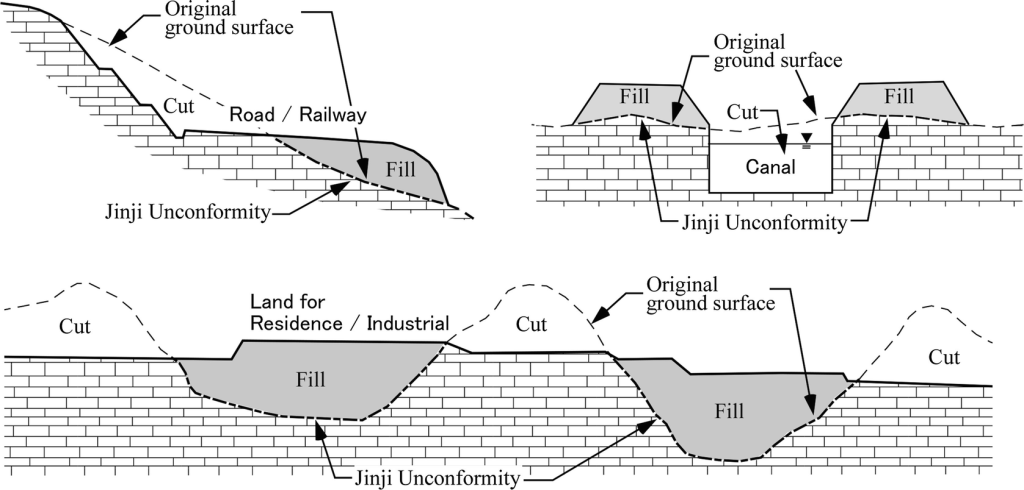
Understanding the clear line between anthropogenic and naturally occurring strata is crucial, as it highlights situations that require site investigations, such as consolidation tests or even triaxial testing, which you can read about in other blog posts.
Related reads: Understanding Triaxial Test: Soil Strength in All Directions, Natural materials – silt
Stability of Embankment
The construction of embankments closely relates to land-cut and -fills. In this context, engineers utilize anthropogenic strata to develop a soil structure that can support the load. However, embankments differ because they typically need specific types of strata that ensure sufficient strength to support the road or railway designed to be carried by the embankment. For those who are unaware, an example of an embankment appears in Figure 6.
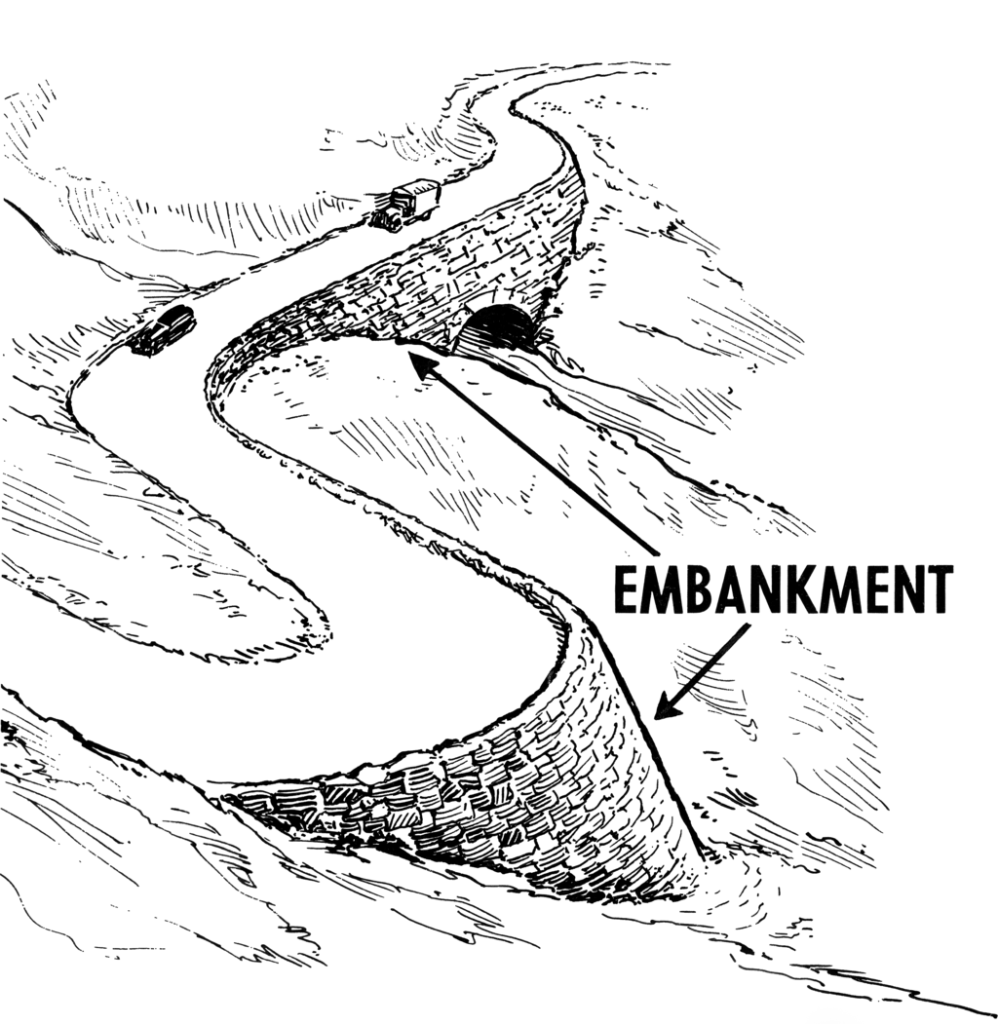
The anthropogenic soil strata is usually consisting of gravel and sand alongside with some sort of rock ensuring a nice and visually stunning exterior while simultaneously ensuring sufficient stability under both rainy and dry conditions as to uphold the structure put on top.
At other times, sand and gravel is not available and thus engineers must resort to using other types of material whose properties might not be as favorable. In these situations the geotechnical engineers would most likely choose to conduct site investigations including consolidation tests in order to ensure a sufficient amount of knowledge is obtained to de-risk the project associated potential failures.
Creep – Second order consolidation
Consolidation is the primary effect however as the soil structure becomes more dense the effect of secondary consolidation begins which considers the soil medium as a very viscous liquid.
In a similar manner to wood, the behavior of soil in a dense state has a tendency to compress further under a constant effective pressure without any loss of pore pressures leading to the effect of the soil only compressing due to the soil structures density changing with time.
Liquid and illiquid behavior
The soil structure’s behavior is quite complex as the almost liquid behavior means that the soil still compresses with time in an ever slower process following the differences in compactness of soil particles.
Books are written on the complex procedure which us the creep of soil under constant pressure however two methods worth mentioning is the linear visco-elastic representation and the green-rivlin theory of multiple integrals method which is considered one of the most complex theories of creep currently presented. For exact details of the methods look in the book references in references.
In order to understand in absolute terms how the process of creep looks and unfolds itself during testing please refer to Figure 7, Where an outline of a typical creep test is presented.
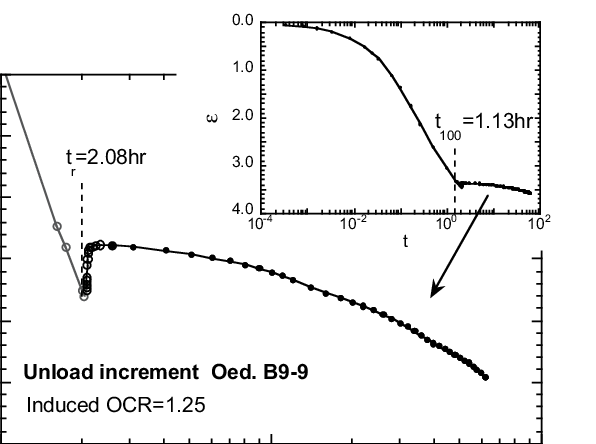
As is seen from the figure the behavior of creep is quite apparent and should be taken seriously in order for the creep to be correctly accounted for. Otherwise buildings and large structures might be subject to permanent damage which is not a feasible solution long term.
Perspectives
While there have been great breakthroughs within recent years, the theory of consolidation including advanced features such as creep and similar is still an active area of research today.
With the advent of computers and advanced material property descriptions encapsulating anisotropic behaviors it becomes increasingly interesting to follow the numerical prediction tools such as FEM (finite element modeling) methodologies as these with higher computer power becomes increasingly accurate with time.
This however is not a substitute for the physical test methodologies which now have existed for more than a hundred years enabling researchers and engineers with valuable and useful data for a variety of projects ranging a wide variety of scales.
References
Vincenzo guerilla, (2022). “1923–2023: One Century since Formulation of the Effective Stress Principle, the Consolidation Theory and Fluid–Porous-Solid Interaction Models”. DOI: https://doi.org/10.3390/geotechnics2040045
Lokkas et al. (2021) “Historical background and evolution of soil mechanics” in WSEAS Transactions on advances in engineering education. DOI: 10.37394/232010.2021.18.10
J. S. Goldsworthy et al. (2004) “Cost of foundation failures due to limited site investigations” in ICSF (International conference on structural and foundation failures.
Yixing Yuan et al (2015) “Model for Predicting and Controlling Creep Settlements with Surcharge Loading”. DOI: http://dx.doi.org/10.3233/978-1-61499-601-9-931
Book reference for creep theory: “Creep of soils and related phenomena” by Jaroslav feda, elsevier 1992.
Old-school oedometer rig Geotechnical Soil and Rock Testing | Sub Surface Ltd
Consolidation curve https://www.geoengineer.org/education/laboratory-testing/soil-consolidation
Jinji unconformity line schematic Cut and Fill | SpringerLink.




Leave a Reply