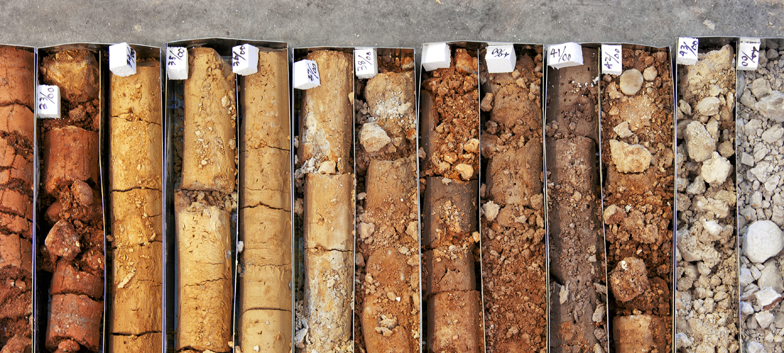
In this blog post, we will explore the two common tests used to describe soil media: the Standard Penetration Test (SPT) and the Cone Penetration Test.
The Standard Penetration Test (SPT) stands out as the most widely used and cost-effective method in geotechnical engineering for quickly characterizing subsurface soil layers. Over the past century, researchers have continually refined the SPT methodology, enhancing its value through ongoing studies and improvements to various procedures.
- History of the standard penetration test
- Early 1920’s Mohr refinement
- Modern day SPT testing
- The SPT procedure
- Result of the SPT test
- Pros and cons
- Perspectives
- References
History of the standard penetration test
Before diving into the nitty gritty details about the two abundant types of tests let’s start by covering some of the history behind the tests.
Early 1900’s ‘How’ discovery
The standard penetration test has as long history of development starting in the early 1900’s with a French engineer named Alphonsē Howalt often shortened to How.
He theorized that a soils strength could be deducted from a specific drop height of a specimen impacting the soil allowing for the determination of the dynamical response of the soil.
This novel approach towards understanding a soils strength was what layered the foundation for further research into the standard penetration test and later on the cone penetration test.
Early 1920’s Mohr refinement
After ‘how’ has made his discoveries came another person with a similar groundbreaking approach building on top of the learnings from the past. His name was Harry Mohr, now famous for the Mohr circles used for everyday geotechnical engineering work across the world.
Mohr standardized the methodology by using a specific weight, grab, rod, and header for the soil samples, enabling meaningful comparisons between individual samples.
The introduction of standardized equipment allowed for the methodology to gain widespread appraisal ensuring the adoption across geographical areas covering the entire country and building the foundation of the modern way of conducting standardized penetration tests.
Mid 1900’s organizational establishment
During the mid 1900’s refinement and standardization followed in an accelerated pace facilitated by large organizational institutions such as the ASTM (American society for testing and materials) which kept introducing new correlation equations based on the adoption from empirical tests and use cases across geological formations.
The test specifically analyzes cohesionless soils and soils with very high cohesion rates by using the number of blows in conjunction with the displacement to theorize the in situ soil strength. To gain a physical understanding of how the standard penetration test works, refer to Figure 1, which outlines the utilization of typical SPT test equipment.
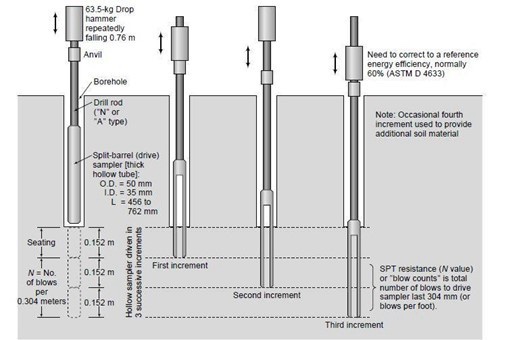
The equipment fails to perform effectively on general cohesion soils because it absorbs water’s impact, which increases pore pressure. Consequently, the outcome hinges more on the interactions between soil and water than on the strength of the soil grains. These interactions dissipate when the soil undergoes prolonged loading.
Related reads: Understanding clay characteristics across Denmark, Understanding Triaxial Test: Soil Strength in All Directions, The Atterberg limits: History, evolution and perspectives
Cohesionless soils like sand and gravel don’t allow water interactions to absorb stresses through pore pressures in the soil medium.
Standardization of the equipment and procedures
The inclusion of correlation maps connects the use of the standardized penetration test to other tests, such as the cone penetration test, enabling senior geotechnical engineers to easily infer qualitative information about soil properties.
However, it’s important to note that these tests alone cannot calculate material strength quantitatively without incorporating other, more refined tests.
To maximize the test’s utility across various locations, the procedure and equipment underwent a rigorous standardization process. This standardization allowed researchers to infer and create new correlations based on extensive empirical data, accurately describing soil characteristics in the general medium.
Modern day SPT testing
In modern times, following the widespread standardization of the SPT methodology and testing equipment, the concept of further refinement is still underway. Additionally, this continuous evolution has, in turn, led to advancements in both the precision and accuracy of the system.
Moreover, contemporary scientists are actively working to harness machine learning techniques, particularly recurrent neural networks, in conjunction with CPT and SPT methods. Consequently, these innovative approaches aim to characterize soil behavior and strength parameters more effectively. As a result, these methodologies are constantly evolving, which significantly enhances our understanding of how SPT methods and data can be utilized effectively.
Furthermore, the insights gained from utilizing this data hold critical value; for instance, they are crucial in elucidating the intricate and highly complex features of soil structure that influence the behavior of cohesion less soils.
The SPT procedure
To gain a comprehensive understanding of the data collected through the SPT methods, it is essential to be aware of how the collection occurs during the application of the SPT technique.
Initially, the apparatus is positioned to drive the specimen head down into the ground. This action is crucial as it precedes the immediate extraction of the specimen following the driving of the head underground.
Subsequently, the pole head enters the ground by adhering to a specified procedure. This process may involve techniques such as deadweight hammers striking the top of the pile, explosives propelling a deadweight into the air, or hydraulic pistons applying downward pressure on the pile from above.
Importantly, different methodologies yield varying energy levels per impact. Consequently, engineers must specify the methods employed and clarify how the blow counts correspond to the differences in applied energy.
Moreover, selecting the appropriate method hinges on several factors, including the available equipment, the size of the construction, and the depth required for the SPT methods. Therefore, it is imperative for engineers to conduct thorough investigations prior to choosing their methods, as each option presents its own unique benefits and limitations within the spectrum of pile driving techniques.
Result of the SPT test
By following the procedure and using standardized test equipment, you can collect a specific data series that correlates the number of blows with soil resistivity, as illustrated in Figure 2, which also includes the CPT tests.
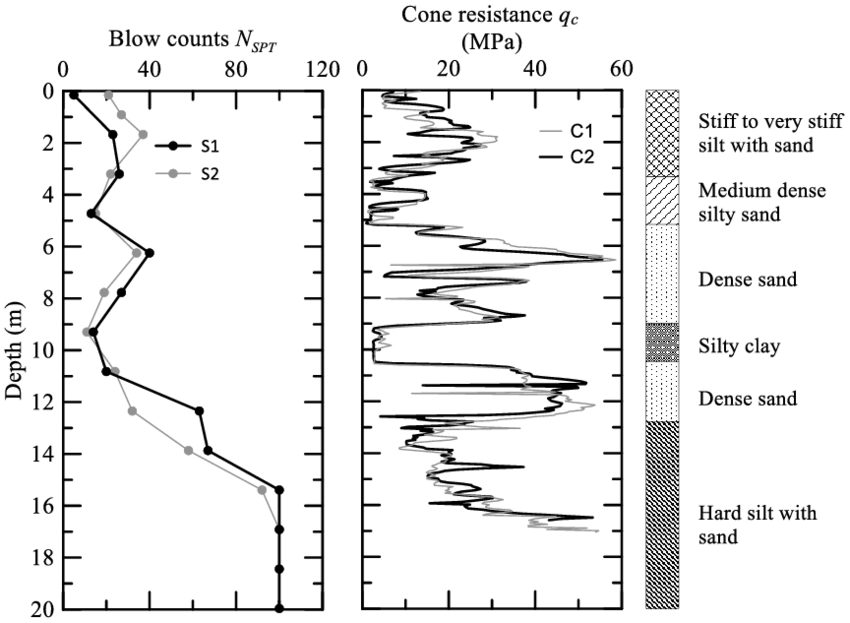
The test allows us to compare it with the general characteristics of the soil profile, leading to vital insights about the soil’s behavior. This comparison provides senior geotechnical engineers with a qualitative understanding of the soil strengths.
Additionally, by analyzing the CPT curve, we can identify the differences between the two tests, clarifying their respective applications and limitations.
Pros and cons
In the following sections we discuss some of the benefits and negatives of the SPT methodology and outline key areas where there are strengths and weaknesses about the gathered test data.
Pros
The SPT test method offers a significant advantage: it’s widely accessible and does not require specialized tools or dedicated labs for execution. This enables engineers to perform the test quickly and effectively, keeping costs and workload low.
Additionally, the common usage of this method facilitates the easy collection and utilization of results, requiring minimal effort to gather preliminary information about various soil characteristics and compare the findings for methodology validation.
By enhancing understanding of underground conditions, this approach effectively advances knowledge frontiers and provides users with reliable access to geotechnical data.
Cons
The SPT test methodology alone cannot accurately interpret the strength parameters of soil due to its inherent inaccuracies in characterizing soil properties. Therefore, it is essential to supplement the test results with additional information to fully understand soil strength parameters.
Moreover, this methodology applies only to non-cohesive soils, leaving a significant portion of the earth—specifically cohesive soils—untested. As a result, this limitation creates gaps in knowledge regarding these soil types, necessitating special measures to uncover the hidden information about them.
Perspectives
The procedure of utilizing the SPT test methodology is common among geotechnical engineers. They increasingly combine SPT data with information from other testing methods, leading to a richer dataset for scientific analysis.
By recognizing the strengths and weaknesses of both the SPT and other methods, engineers can eventually integrate machine learning approaches into their routine data analysis. This integration can enhance predictions of future data collected through these methodologies.
However, the development of AI-assisted solutions is still in its infancy. Currently, human experts map out differences in measurement data and interpretation, using engineering judgment as needed.
Overall, the SPT method is a widely used, standardized, precise, fast, and cost-effective way to gain valuable insights into the fundamental properties of soils at various locations. Scientists continuously refine the methodologies and procedures for the standard penetration test, and as advancements occur, the industry gradually adopts these innovations.
References
Han et al. 2018. “Static and Dynamic Pile Load Tests on Closed-Ended Driven Pipe Pile” DOI: http://dx.doi.org/10.1061/9780784481578.047
Image of the standard penetration test equipment. https://www.geoengineer.org/education/site-characterization-in-situ-testing-general/standard-penetration-testing-spt






 The Skjærup blueprint
Leave a comment