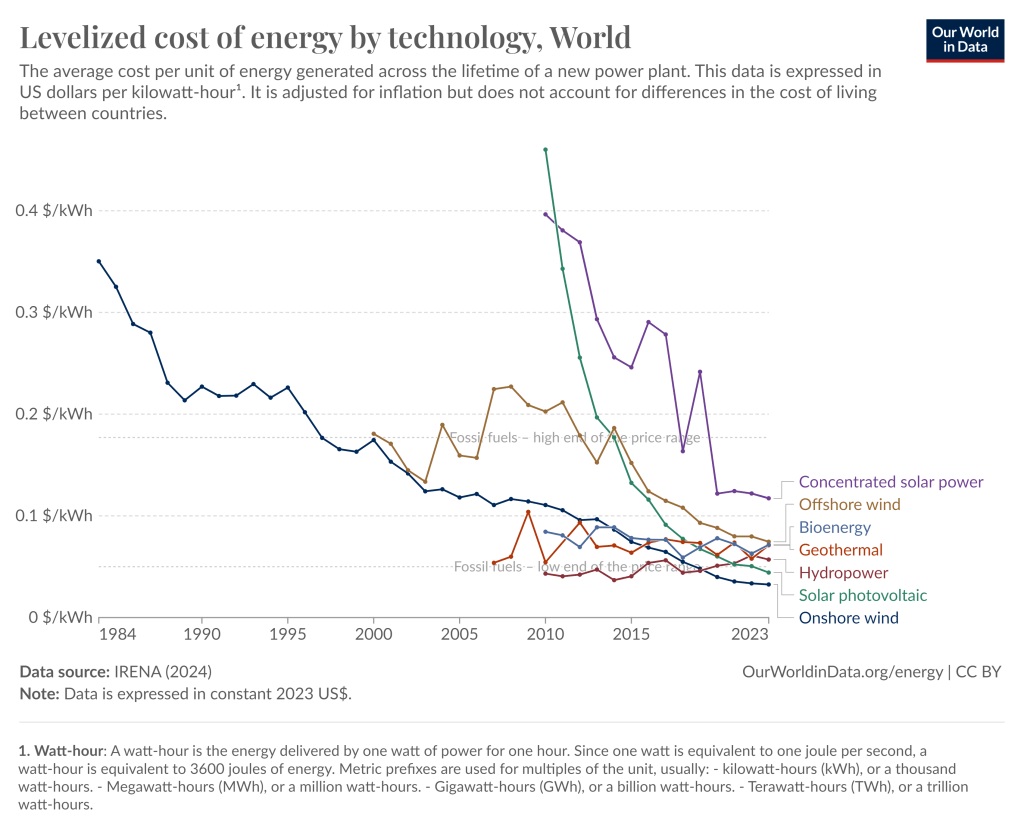
In this blog post, we discuss offshore engineering and future energy production as well as how the energy sector is evolving from oil and gas to renewable sources. We outline key concepts for combating climate change and examine effects like the increased intensity and frequency of hurricanes.
- History of offshore engineering
- Initial challenges encountered during offshore construction and redefinition
- Energy consumption evolution across two centuries
- Increasing living standards
- Benefits of increased energy consumption
- Emerging problems for future generations
- New and emerging energy supply technologies
- Balancing a transformative energy grid
- Perspectives
- References
History of offshore engineering
The history of offshore engineering dates back to the early 1900’s with the exploration and discovery of offshore oil and gas reserves in the subsurface off the west coast of the USA. Here it was first theorized that the exploration and subsequent harnessing of offshore subsurface oil and gas wells was possible to a point where it might become profitable in the long run.
This followed an era when companies primarily produced oil and gas through land operations and developed new technologies to identify reserves located offshore underground.
This allowed for the exploration of geotechnical historic developments including the origins of the oil reserves and how tectonic formations might have occurred for millennia in order to end up and produce such geo-technical strata.
Related read: Understanding clay characteristics across Denmark, Understanding Triaxial Test: Soil Strength in All Directions, The Atterberg limits: History, evolution and perspectives.
Mobilizing the entire industry from onshore to offshore operations presented significant challenges, as engineers had to redesign the complex industrial piping, processing, and drilling equipment to ensure proper and safe use in the significantly harsher offshore environment.
New designs and repurposing
The re-designing of the equipment and engineering designs necessary to make such a transformation offshore required tremendous efforts in particular for the offshore structural steel and complexity when designing piping’s, etc. This makes the entire feat significantly more complicated than building something onshore.
In order to facilitate such a transition it was likewise necessary with the transformation of cross-disciplinary industries allowing for the development of new factories, steel manufacturing plants and chemical oil refineries to accommodate the transition from onshore to offshore.
This transition presents multifaceted challenges, as environmental, financial, and technical difficulties emerge while transforming highly complex infrastructure from land-based to offshore operations.
Initial challenges encountered during offshore construction and redefinition
Initially, it became quite clear that the offshore environment is harsh and unrelenting. This complicates matters significantly especially when trying to design offshore steel structures. The combination of wind, sea and currents alongside with salt, temperature differences and seabed interactions made it abundantly clear that new innovations and redefinitions of status quo was necessary.
This fostered the curiosity of industrial researchers looking into new ways and methods for conducting chemical and civil engineering.
Related reads: The Atterberg limits: History, evolution and perspectives, Evolution of the standard penetration test (SPT).
This in turn led to the development of new innovations within corrosion resistant paintings, structural monitoring and electrical equipment in order for the design of offshore oil and gas-installations were feasible. Alongside with the development of new chemical mixtures, synthesis and safety measures keeping the industry afloat.
Innovative research and developments
The new innovations often spilled over in other industries than oil and gas collection as they too could utilize the developments created.
Research conducted in the oil and gas industry benefits several other industries, including shipping and manufacturing, where major issues like corrosion have posed significant challenges. Even today, companies heavily invest in and research solutions to address this problem.
Related industries benefiting from innovations include the aerial and aerospace industries, where engineers apply learnings about vibrations and dynamics to reduce wear and extend the lifetimes of wings and jet engines, among other key developments.
As the offshore industry advanced, exploring deeper waters became feasible, significantly boosting oil and gas production. This progress posed a greater challenge for engineers and scientists: designing massive steel structures capable of withstanding increased forces while, in some cases, remaining afloat on the ocean’s surface. This optimization process led to the development of numerous designs and concepts, all of which underwent thorough testing and analysis.
Different types of rigs with associated benefits and downsides
Some of the most remarkable innovations within the offshore oil and gas industries is the submersible drilling rigs, allowing for the construction and subsequent submersion of an offshore drilling rig. This way enabled easy installation by ship offshore to the construction site. Other developments included Jack-up rigs reaching and penetrating the seafloor, this enabled a solid foundation working as a duplicate reef for marine animals feeding on mussels and other types of bio-fouling growing on the hard structures.
One of the upsides of this method is it in-situ installation and subsequent utilization for prolonged periods of time while simultaneously allowing for safe operation once installed.
However, one downside of this type of construction is the installation process, which requires hammering offshore in shallow areas to deploy the rig efficiently.
This way of installation can unfortunately harm wildlife such as mammals and sea creatures, which are at the mercy of human activity. This is particularly true for hammering and jack-up rigs deployed offshore.
Significant hazards for marine mammals
The reason for harm of sea creatures is the immediate and substantial noise produced from the hammering activities, reaching noise levels of 200 dB at 1 uPa at a distance of 750 m from the pile driving position, see source for more information. This compares to the average sound of a jet engine at approximately 160 dB, meaning offshore ramming noises are much louder than typical human air-noise levels.
One of the remedies behind the offshore pile driving procedures is the development of noise cancellation nets, or so-called hydro sound dampers. Underwater curtains surround the base of the pile and extend to the surface, effectively obstructing the dispersion and movement of sound pressure waves by introducing another medium.
Mitigation strategies for noise issues
Scientists have studied the distribution and dispersion of sound pressure waves to understand how sound behaves underwater, focusing on its attenuation and transformation. Research indicates that the most effective way to mitigate the impact of offshore noise on marine mammals is by using air-bubbles. These bubbles are crucial for disrupting sound waves in the water, as introducing another phase—air—disturbs the forward movement of sound through the medium.
Air curtains are particularly effective in reducing noise pollution during offshore rig installations, helping protect marine mammals from potential harm caused by construction activities. For a detailed example of an installation using an air-bubble curtain, see the image below, which illustrates this use case.
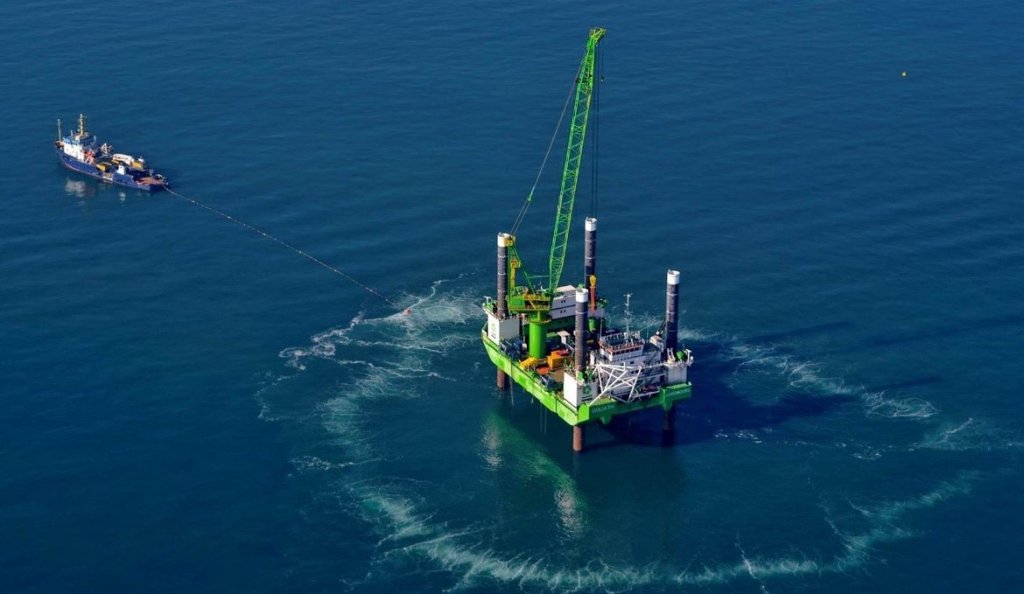
By ensuring an efficient mitigation strategy for the offshore hammering of jack-ups we allow the biodiverse development and evolution of the offshore installation environment. These possibilities of creating an environment capable of holding wildlife and biodiversity while simultaneously harnessing the immense energy reserves necessary for keeping a society running is an example of human ingenuity at its finest.
This is just a small example of the plethora of problems present in the offshore industry and that spills over for the development of newer industrial projects such as offshore wind farms and transformer stations alongside cable laying facilities.
The reason for keeping up the evolution of oil and gas facilities become quite apparent when looking at the consumption curves for energy worldwide.
Energy consumption evolution across two centuries
The need to harness underground storage and reserves has become increasingly apparent as society’s demand for energy grows, driven by the revolutionary invention of the combustion engine. This innovation fundamentally transformed society and reshaped the world order, leading to a surge in production.
The introduction of the combustion engine revolutionized every aspect of society by freeing hands and minds from manual labor, allowing for more intellectual work. This shift sparked groundbreaking ideas that fueled productivity across various sectors. This revolution in energy sources continues to drive innovation to this day.
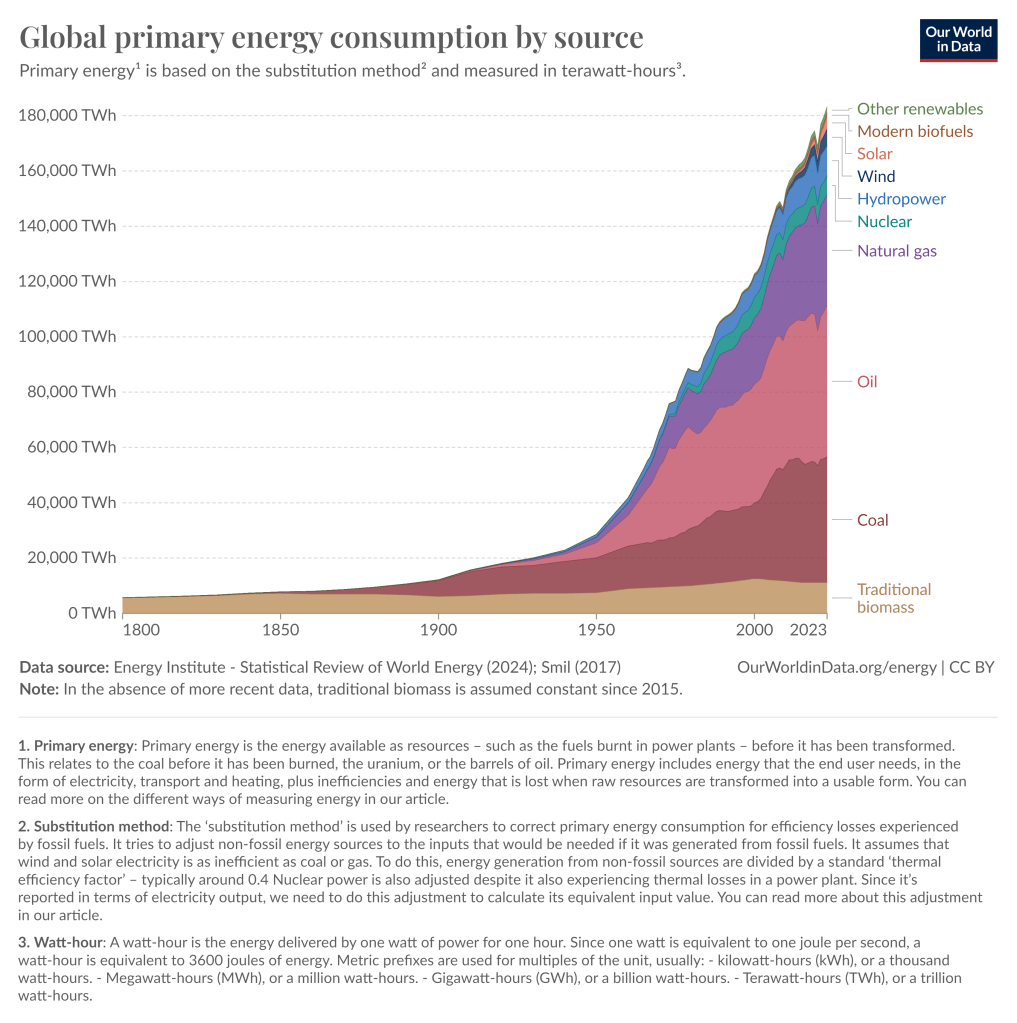
As shown in the graph, energy production has rapidly increased over the past 70 years, with a sharp rise in global consumption. This increase in consumption is essential for providing the broader public with access to previously inaccessible resources, such as clean drinking water, heating, and electricity, which in turn enable the flow of information.
One of the key benefits of having more energy available for consumption is the general increase in living standards correlated with energy usage as it allows the general public to utilize synergetic tendencies towards increasing production of goods and services benefitting all. As an example lets look into the evolution of living standards as measured across multiple parameters.
Increasing living standards
The increased living standards across the world in the previous century directly resulted in higher energy consumption demand, as electrification and urbanization spread and took control.
This accelerates developments of new initiatives further leading to increased opportunities for a broader variety of the population ensuring that each person has the ability to change the social-economic status of the person through innovative thinking and purposely development aiming at increasing living standards for the broader public.

This means that many aspects of society can improve, such as the increase in literacy rates among people at all societal levels, which enables a more intellectually engaged public and empowers the right ideas across society.
The distribution of democracy and the reduction of poverty clearly demonstrate this trend, with dramatic improvements alongside the decreasing child mortality rate.
Benefits of increased energy consumption
Through the Industrial revolution it suddenly became possible for the masses to acquire things that were previously unavailable to the majority of people. This meant that previous scarcities such as toys and clothes suddenly became something which everyone could enjoy.
Other benefits include increased life expectancy even for people not undertaking education or working within expensive fields of engineering and science. Improved work-life balance with an increasing proportion of the population being able to work in jobs creating value in the service industry and consultancy services.

The increased living standards of people is possible primary because of the general increase in production capabilities in all aspects of society from farmlands to factories.
The amazing development we have seen have however have drastic consequences for the general climate and biodiversity which includes the introduction of human made CO2 emissions leading to the increased temperatures across the globe.
Emerging problems for future generations
Climate change is the number one problem which future generations need to consider as the all encompassing weather is subjecting every living and dead being all the time. With increased temperatures across the globe comes a variety of serious changes and worst of all is that the most devastating events are becoming increasingly violent as a result of the global warming.
Related read: Tsunamis. The what, when and where., Earthquake proofing buildings, Impact of Ocean Currents on Marine Ecosystems
Unfortunately, natural catastrophes increase in a non-linear sense meaning that small changes in the temperature and energy input to the world oceans leads to significant changes in intensity and frequency meaning that they become ever more evident with time and magnitudes of wind speeds, currents and the like increases as a consequence of the global climate changes.
Human induced climate change
The changes in the climate, particularly those induced by human activities poses a significant threat for anyone living near coastal areas as melting ice and snow from poles leads to increased water levels across the globe.
The increasing water levels force poor communities, which lack the means to withstand or combat rising sea levels, to relocate, displacing millions of people.
Such human migrations poses challenges for other established societies as the population growth can be rapid exceeding the developmental capabilities of society to provide additional housing and food alongside shelter for those affected.
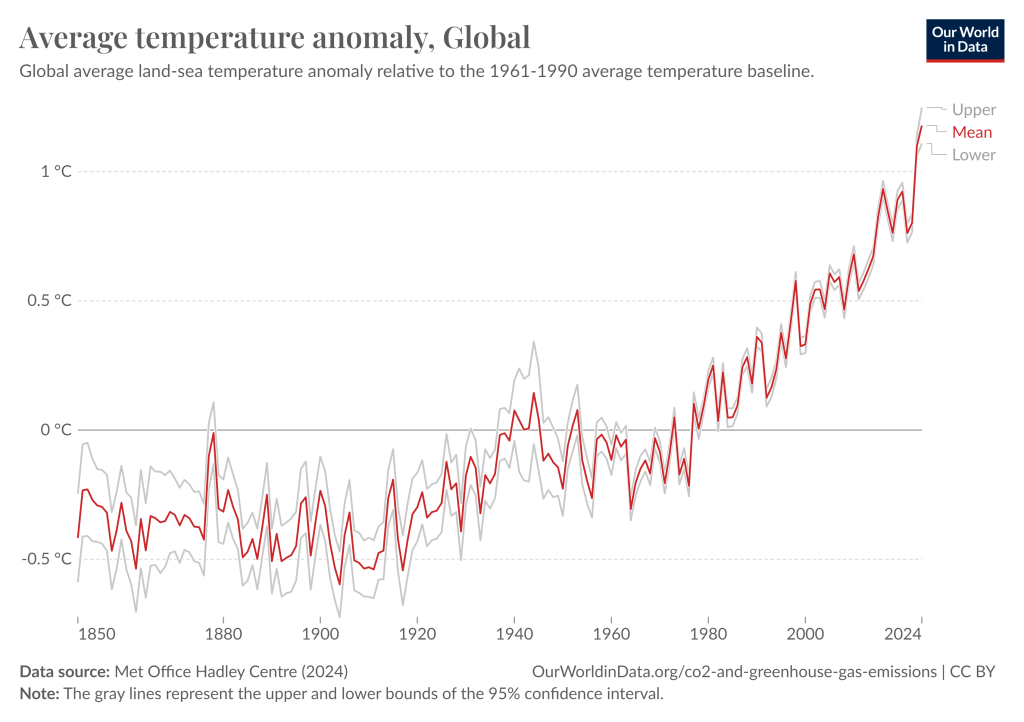
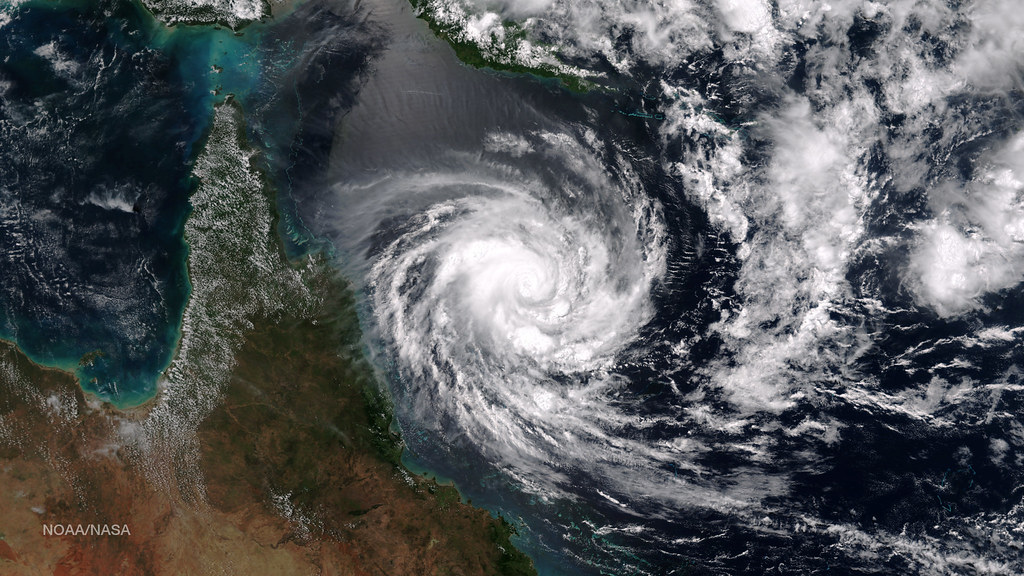
The increased intensity of hurricanes will forcibly remove and create chaos for those involved. This means that coastal cities are also more vulnerable for incoming stormy weather not mentioning the combination with increased water levels leading to synergistic effects affecting communities badly.
The primary warming of the globe causes secondary effects, which occur with a delay after the aerial temperature increases because the oceans absorb large amounts of heat. These dissipative effects take extensive periods to stabilize at the new, higher average temperatures.
Storm intensities and frequency changes hitting poor societies
As a result, experts expect the storm intensities and frequencies to increase in the coming decades as the globe changes and settles into a new normal condition. Therefore, we advise taking precautions against the adverse weather effects expected in the coming centuries.
These adverse effects primarily stem from the increased CO2 content and other greenhouse gas emissions. Governments have implemented policies and laws at both national and international levels to build a society free from emission-generating energy sources.
Since society still largely depends on oil and gas production and usage, authorities expect the entire production capacity to shift in order to accommodate new initiatives, such as offshore wind farms, hydro-power infrastructure, and the electrification of the transportation industry.
However, given the apparent risk to future generations from ongoing global warming and climate change projections, we need new ideas to mitigate the expected changes in weather extremes.
New and emerging energy supply technologies
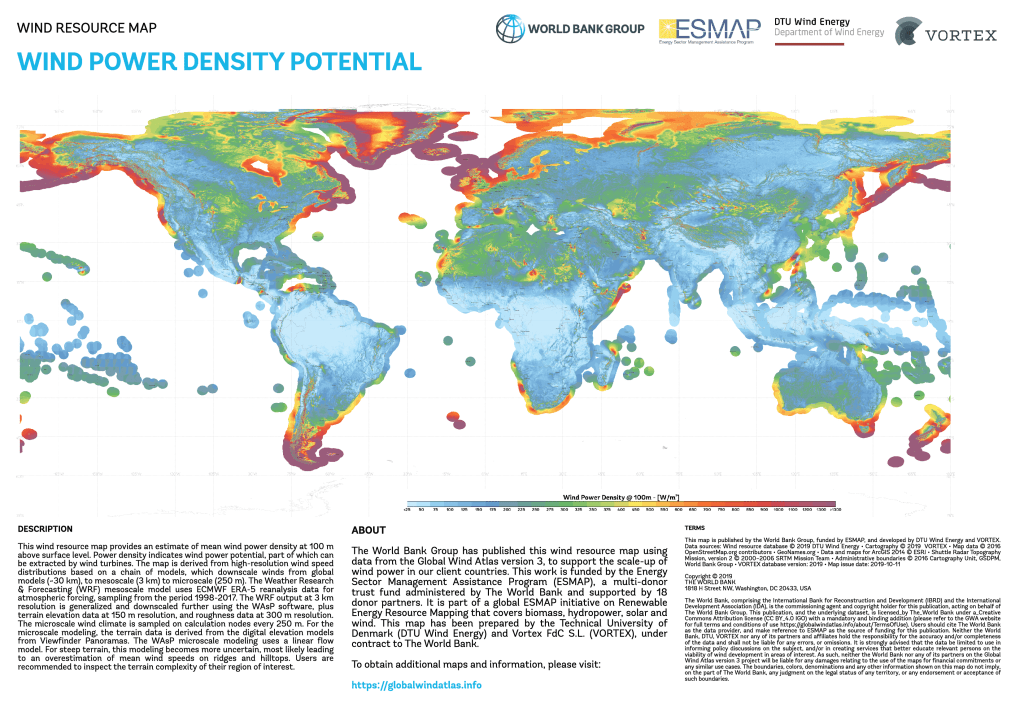
The introduction of renewable energy alternatives is a necessity in order to mitigate the adverse effects that human made climate change causes the planet. With the introduction and modernization of old windmill technology is one of the foundations on which the modern electricity grid will be based on.
Offshore wind is an industry that harnesses wind power across a wide range of wind conditions, ensuring optimal energy production.
Another alternative being deployed on a large scale is solar power, with panels that convert sunlight into usable electrical energy. This technology is especially beneficial in regions near the equator, where sunlight is abundant for most of the year.
Hydropower plants and dams
Another option is hydropower plants where reservoirs located high and low ensure that the continual production of power through turbines is possible. This is especially useful in countries like Switzerland and Norway where terrain allow for comparably cheap implementations. However there are also examples in USA and China of similar plants built on dam foundations instead of natural reservoirs some of the most famous examples include the hoover dam and three gorges dam respectively.
The introduction of alternative energy sources is a step in the right direction however it poses new problems particularly in the stabilization of the energy grid which is heavily reliant on the continual production and consumption of electrical energy ensuring that frequencies remain within a small specified range. If disturbed this can lead to blackouts and similar happenings across large scales.
Balancing a transformative energy grid
In cases where alternative energy producers cannot meet demand—such as on quiet nights or during cloudy weather—traditional coal-powered plants may need to be activated to stabilize the grid. If left out, blackouts and cutouts of entire communities will occur leading to disruptions for a large majority of the population.
It goes without saying that such disruptions are unsatisfactory as the general public is becoming reliant on easily available power for various activities both industrial and leisure activities.
One of the key challenges for the general public is energy storage. The widespread availability of oil and gas makes it relatively easy to generate and maintain a stable electrical grid over extended periods. A strength of the old fashioned energy sources which new renewables do not have.
For these reasons, new methods of storing energy are needed to stabilize and optimize both energy production and consumption. These challenges must be addressed to ensure a reliable energy supply for future generations.
Perspectives
The production and consumption is one of the most important aspects of modern living as it enables societies to transform and utilize a larger majority of the available resource in a more effective manner.
The increased consumption of energy has lead to major improvements for the average human being on a plethora of aspects such as economic, health and social status. This leads to a population where the majority is able to sustain a comfortable lifestyle without having to conduct bone-breaking work in fields or industries all together.
The challenges faced by younger generations are different from older generations as the human induced climate change contributes to significantly changed ways of living for animals and humans alike. The old ways of utilizing oil and gas in combustion engines need to change in order to accommodate sustainable change for the underlying energy infrastructure.
References
“EFFECTIVE MITIGATION METHOD FOR OFFSHORE
PILING NOISE” Karl-Heinz Elmer. Proceedings of the institute of Acoustics.
Our world in data – https://ourworldindata.org/global-energy-200-years. Visited 22-12-2024.
Our world in data – https://ourworldindata.org/a-history-of-global-living-conditions. Visited 22-12-2024.
 The Skjærup blueprint
Leave a comment